




It’s an old but familiar expression: “Politics makes strange bedfellows.”
Originally derived from William Shakespeare’s play The Tempest, it highlights unusual and often unexpected alliances among traditional political adversaries. Our state and nation are witnessing this rare phenomenon on the issue of artificial intelligence (AI) and data centers. People who strongly disagree on the issues of abortion, immigration, taxes, crime, and males playing in female sports are uniting in their opposition to AI and the buildings filled with servers that power it.

The numerous concerns expressed should not be dismissed but rather should be heard and addressed by stakeholders and subject matter experts – AI developers, data center operators, economic developers, ethicists, regulators, and elected officials at all levels.
We should step back from the hyperbole and online fodder to frame the various objections and concerns with facts. We can advance AI and expand our data center capacity necessary to power our digital world in an ethical, responsible, and safe manner that protects our environment and prioritizes humans.
What is Artificial Intelligence?
In simple terms, artificial intelligence is an enabling technology that empowers computers and machines to simulate human intelligence. AI can perform tasks that typically require human cognitive skill, such as learning, reasoning, recognizing images, speech, and patterns, and generating content – from text to images to program code.
There are three broad categories of AI:
Narrow AI – Performs specific tasks, such as ChatGPT, Claude, Gemini, and Grok, which generate content based on user prompts. Widely used today.
General AI – Designed to perform virtually any human intellectual task. Does not exist; hypothetical today.
Super AI – Systems that could exceed human intelligence. Theoretical. Speculative.
What is a data center?
A hardened, secure, and conditioned room or building that is designed and purpose-built to house information technology assets.
Data Centers are comprised of two major component categories: physical infrastructure and Information Technology (IT) infrastructure.
Physical infrastructure includes buildings, power systems, cooling systems, physical security technology, fire suppression systems, humidifiers, structured cabling, and equipment racks.
IT infrastructure includes network routers and switch electronics, computer servers, storage arrays, cybersecurity devices and software, network enhancement appliances, and remote management and monitoring tools.
There are five major categories of data centers, based on purpose and ownership:
Enterprise – Owned and operated by a single entity for restricted and secured use for their exclusive internal use.
Colocation – shared spaces where floor and/or rack space is leased by organizations to house their IT equipment. Customers pay for “ping, power and pipe.”
Cloud – Highly efficient, rapidly scalable, highly virtualized pooled IT infrastructure is used to deliver IT-related functions and workloads “as a service” via the Internet or private connectivity. Major players are Amazon Web Services (AWS), Microsoft Azure, Oracle Multicloud, and Google Cloud.
Hyperscale – Massive data center campuses designed to accommodate demanding workloads such as artificial intelligence and quantum computing. The biggest cloud services providers are also engaged in a hyperscale strategy.
Edge – small footprint facilities, positioned within proximity of end-users, which augment large central cloud platforms and reduce latency.
There are over 3,500 active data centers in the United States, with over 1,500 currently in various stages of development. Virtually every digital action is powered by a data center. Think of your personal electronic device – smartphone, pad, or personal computer as a “remote control” for data centers.
Transportation infrastructure facilitates the movement of people and goods that power our economy. Data centers host and deliver the IT solutions that organizations and individuals rely on to produce and consume goods and services. Next to human capital, data is an organization’s most precious asset. Success is not possible without good people and the digital tools they use to produce organizational and societal value. Data centers power those tools.
Checking your bank balance, scrolling social media, trading stocks, performing a Google search, creating a video, streaming a movie, ordering (anything) online, sending a text message, driving your vehicle, flying on an airplane, enjoying a sporting or entertainment event – EVERY digital interaction utilizes data centers. You’d be hard-pressed to find a public sector entity or a private business – of any size and in any industry – that does not rely on workloads powered by data centers.
It is estimated that Americans use data centers at least 40 times per day on average. That number is likely conservative and grows by the day as new tools and applications are introduced.
For the past couple of decades, public and private sector organizations across the industry spectrum have been moving their IT workloads to the cloud. Why? The value proposition is compelling. Lower up-front capital expenditures (capex), predictable costs, implementation speed, agility, scalability, reliability, robust physical and cybersecurity, and ubiquitous access.
Restaurants, retailers, hospitals and clinics, professional services firms, hotels, airlines, trucking companies, banks, wealth managers, convenience stores, dry cleaners, builders, manufacturers, churches, schools, utilities, law enforcement, courts, correctional institutions, repair shops, veterinarians, etc. rely on data centers.
So does every city, county, state, and federal agency. The Department of War relies on AI and data centers to protect the nation. The U.S. military operations in Venezuela and Iran rely heavily on AI tools powered by data centers. The Pentagon has a $9 billion cloud services contract split among Amazon Web Services, Google, Microsoft, and Oracle.
Cloud architectures enable small businesses to harness the same powerful IT infrastructure leveraged by larger enterprises. Don’t be surprised to see the emergence of billion-dollar annual revenue companies with a single owner-employee. Made possible by data center-powered cloud services.
The recent surge in the construction of new data centers, such as in Mississippi, is being largely driven by the AI revolution. Virtually every company, not-for-profit, and public sector entity in America is currently engaged in a significant effort to incorporate AI into their operations. The hyperscalers are rushing to stand up data centers that house the network, compute, and storage horsepower to accommodate exploding demand. While AI workloads require more IT infrastructure, today, AI accounts for about 30% of total data center capacity and power. That share is projected to balloon to 50% by 2030.
Virtually every day, companies across the industry spectrum announce the inclusion of AI in their product or service, seeking to enhance service delivery and value creation. Innovators are leveraging AI to create new hardware, software applications, and new electronic tools, thus expanding their physical and digital footprint.
The advent of AI and cloud technologies has spurred the creation of new solutions to human problems by American innovators.
Consider Strella Biotechnology, founded by CEO Katherine Sizov. While studying molecular biology at Penn State University, Katherine, 30, discovered that 40% of our food is wasted. Strella created biosensors and data solutions to track food ripeness while in storage, staged for distribution to retailers. Instead of “guessing” and manually inspecting to determine food maturity, IoT (Internet of Things) devices produce data analytics used by growers and distributors to optimize supply chain management and reduce food waste. Last year Strella’s solution processed over 2 billion pounds of produce and saved 20 million pounds from spoilage and waste. Powered by cloud IT architectures hosted in data centers.
Because detection often occurs when the disease has progressed, a pancreatic cancer diagnosis is often a death sentence. MIT researchers have developed a new AI model capable of assessing a patient’s risk of pancreatic cancer. “The model could potentially expand the group of patients who can benefit from early pancreatic cancer screening from 10% to 35%. Saving lives. Again, powered by AI, hosted in data centers.
Another innovative solution recently introduced comes from Zum Services, whose AI-powered student transportation solution delivers real-time visibility for parents, reduces school district transportation costs and commute times, and provides real-time parental tracking. Powered by data centers.
At the time of this article’s publication, the head of Anthropic, Dario Amodei, called for a slowdown in artificial intelligence development in a 3,800-word essay. Anthropic is the maker of a family of AI tools and assistants, including the popular Claude AI assistant. Other AI industry leaders, including Elon Musk of SpaceX and Sam Altman, the CEO of OpenAI (ChatGPT), expressed their support for moderating the pace of AI development.
In the essay, the Anthropic CEO warned of possible safety risks and said: “that fully addressing the risks requires even more prudence — not just investing in risk prevention but pacing the rate of capabilities advancement so that risk prevention has time to keep up.”
However, Mr. Amodei made it clear that he is not proposing a total halt of AI development, but rather, he just wants to slow down the pace. He also said that under his proposed combination of self-regulatory and government oversight framework, “Progress will still seem fast, and we must make wise use of the time we gain.” Amodei believes “that AI could dramatically raise the quality of human life.” In the essay, he said that he believes “that AI could cure most major diseases in the next 5–10 years, greatly accelerate economic growth rates, create a world of abundance and empowerment, and usher in a renaissance of democracy and freedom.”
In response to the slowdown Amodei recommended, President Trump and his AI adviser David Sacks cautioned against overregulation of the technology.
“We can put up guardrails, and we can do this and that, but I think you have a lot of negative forces that are bringing it up,” Trump said. “And they’re bringing up things that won’t happen.”
The president said forcefully that the U.S. must maintain technical superiority over China in the AI race. He reiterated his position that “whoever wins AI wins.”
Meanwhile, China is plowing ahead, vigorously and aggressively pursuing its artificial intelligence strategy. They celebrate every time a domestic data center project is derailed, and they’re absolutely giddy about the prospect of American AI companies slowing down development.
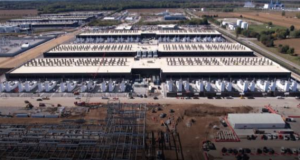
Typical data center exterior
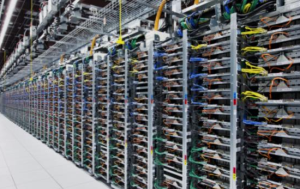
Typical data center interior
Cloud Services
Below, we explore the major objections and concerns regarding data centers.
Concern: Data centers are taking up farmland
Data center buildings are large, typically 100,000 to 250,000 square feet. A data center footprint requires lots of land. Fortunately, the United States is a very large country of 2.26 billion acres of land with approximately 2.18 billion acres (or 97%) undeveloped. Farms, forests, open rangelands, and protected wilderness comprise the nation’s vast expanse of undeveloped land.
Very few data centers are constructed on land previously used for agriculture. Total land used by data centers in the United States is roughly 4,000,000 acres. That’s 0.17% of the nation’s total acreage. The 7 data center sites in Mississippi use slightly less than 3,500 acres combined. Mississippi has 32 million acres. Thus, data centers account for .01% of Mississippi’s total land mass. Even accounting for the land required for new power generation and transmission infrastructure required to support data centers, their total land use would still represent well under 1% of U.S. real estate.
Concern: Data centers drive up electricity costs for ratepayers
Fundamental economic principles hold that when demand exceeds supply of a commodity, its price spikes. A narrative is being promoted that when data centers come to town, ratepayers will be saddled with higher electric bills, simply because of the surge in demand for power from data centers. That is not true.
A common public assumption is that electric utility providers are expanding generation and transmission capacity to accommodate data centers, while passing on those costs to non-data center customers. This perception is to some extent driven by concerns over confidential contracts between data centers and electric utility companies for services. The worry is that to lure these giant data center customers, electric utility companies negotiate rates with the hyperscalers that are insufficient to cover the cost of the electricity they consume. Thus, non-data center ratepayers will effectively subsidize the electricity consumed by big data centers. This is also not true.
The economic model employed by electricity providers is rather unique. The principal costs associated with generating and delivering electricity are fixed – comprising the electrical infrastructure (substations, poles, wires) and operations and maintenance costs to maintain the infrastructure. The primary variable cost in transmitting electrons across the grid is fuel to power generation plants. Variable costs scale with electricity used, but the fixed costs are static – regardless of usage.
Entergy is making massive investments in new generation and transmission capacity in Mississippi to accommodate the increased demand from data centers serviced by the electricity provider. While the contract between Entergy and its data center customers, such as AWS in Madison, is confidential, SB 2001 – the measure that established the state’s incentive package for data centers – specifies that the agreement “shall be designed to provide other customers of the public utility with an economic benefit resulting from the customer’s added electrical service.”
To ensure reliable, resilient delivery of electricity, utility providers constantly modernize their grids, often replacing old infrastructure that has exhausted its useful life. While generation costs have declined over the past couple of decades, the cost of transmission components has increased. Specifically, the cost of transformers and wires has risen significantly, by as much as 2 to 4 times over the past 5 years. So, with or without data centers, the cost of electricity is expected to rise, driven by higher costs of the infrastructure required to push electrons over wires.
Adding big electricity consumers to the grid, such as data centers, distributes those fixed costs over more ratepayers, both commercial and residential. That’s the economic principle of “economies of scale” in action. As a result, Entergy projects cost savings of $2 billion over 20 years for Mississippi customers, with residential rates being 16% lower in
2030 than they would have been without the utility’s large data center customers. Additionally, customers will enjoy improved reliability through grid-strengthening without incurring higher costs. A recent report published by the nonprofit Electric Power Research Institute (EPRI) found that data centers pushed retail rates down modestly from 2015 to 2024. Again, the data center boom’s impact on rates is a function of spreading the high fixed costs associated with producing and transmitting electricity over more customers.
Several large utilities have already announced lowering residential rates because of the addition of data centers to their grids, including Georgia Public Service Commission, Entergy, and American Electric Power (Michigan and Indiana).
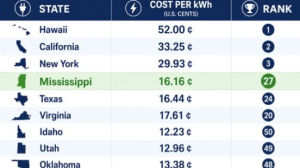
Texas and Virginia, the two states that are home to more data centers than any other state, have electric power rates that are lower than the national average. Mississippi’s electricity rates clock in at 16.16 cents per kWh, 13% lower than the national average of 18.44 cents per kWh.
The chart below shows electricity rates and ranks for states with the highest rates — Mississippi, Texas, and Virginia (two states that feature the most data centers) — and states with the lowest rates.
The key to protecting against rising electricity rates due to increased demand from data centers is to match the increase with a boost in the supply of power. In addition to investment in fossil fuel-powered generation plants, numerous utility companies are planning construction of new nuclear reactors. All the hyperscalers are investing in new nuclear power plants, both through purchase agreements with utility companies and direct investments for dedicated behind-the-meter facilities to power new data centers. For example, Microsoft recently signed a 20-year Power Purchase Agreement (PPA) to restart Three Mile Island 1 to support new data centers to fuel the tech giant’s expanding artificial intelligence and cloud computing business.
In 2025, President Trump signed four executive orders designed to establish a framework for unleashing American nuclear energy. On July 24th of this year, the U.S. Department of Energy released a Fact Sheet entitled “The Golden Era of American Nuclear Energy has Arrived,” detailing the agency’s actions and policies designed to promote domestic development of nuclear power. The Fact Sheet includes a detailed account of efforts and accomplishments over the past year to meet the President’s goal of bolstering America’s nuclear footprint.
Never underestimate the power of American innovation to address society’s challenges, including the need for more power. Innovators who founded Hyliion Holdings, creators of fuel-agnostic linear generators, and Base Power, makers of distributed battery storage systems, are focused on developing novel technology to expand the supply of electricity. Entrepreneurs always respond to market opportunities.
Building the electrical infrastructure to handle the increased demand by data centers is expensive. Utility companies invest billions of dollars up front that are recovered from future revenues derived from the data center operators. Often, these massive investments are financed by long-term debt which is serviced by the expectation of long-term, predictable revenue streams from data centers. But what happens if the dire prediction of an AI bubble bursting occurs, resulting in data center shutdowns before the utility’s investment has been recovered? Will residential ratepayers be stuck with the tab?
Is a total crash of the AI industry possible? Of course, there are no guarantees in business. But it is highly unlikely. The development of Artificial Intelligence is in the embryonic stage. All the hyperscalers reported sharp growth in their latest quarterly reports, with Google leading the others, registering an 82% year-over-year increase. All are guiding a robust outlook, with Microsoft stunning investors with a $678 billion backlog for its Azure cloud services. Still, the future could bring lots of disruption, consolidation – even technological advances that would require less physical space to deliver the same performance and capacity. But does that mean the data centers being built today would not be needed in the future?
Hardly. The IT hardware and physical infrastructure housed in data centers is fairly application software agnostic. Regardless of who wins and provides the end-user software
tools to the market, the IT infrastructure that powers it will be needed. Data center facilities could (and will) be repurposed – multiple times, potentially. But there will never be a time when the world needs less compute, networking and storage infrastructure. Quite the opposite, making data centers not only needed, but an asset with low risk of shuttering.
Certainly, that risk is not sufficient to justify banning or declining to participate in the exploding generational build-out of the nation’s artificial intelligence factories.
Concern: Data centers drain our drinking water
The temperature inside a data center must be maintained within a range suitable for operation of IT equipment. Servers and processors, networking electronics, storage devices, and power distribution systems generate thermal heat. Fans installed in the equipment cases pull heat away from processors and internal circuitry. Cooling systems absorb the thermal energy, expel the waste heat outside, and introduce chilled air into the aisle space between the equipment racks.
Some data centers are exclusively air-cooled. Others use water to augment air cooling systems. Water is used during hot periods when air cooling alone is not adequate to absorb heat produced by the IT equipment installed in a data center.
Some data centers utilize open-loop water systems, and some use closed-loop water systems. Open loop systems draw in new water and discharge it after use. Closed-loop systems continuously recirculate the same water through sealed pipes. Open loop systems may draw water from potable sources or from purified wastewater.
But how much water do data centers use? Water usage, like the federal budget, involves very large numbers. Many hear the figures reflecting water usage by data centers and immediately conclude that such a large volume is severely stressing our drinking supplies. Billions sound like an awful lot – until trillions enter the picture.
The U.S. consumes 117 TRILLION gallons of water annually. Aggregate annual usage by domestic data centers totals 17.5 billion gallons, or .014% of total water consumption.
Projected annual water usage by the 7 data center sites currently under construction in Mississippi totals 200 million gallons. Mississippi uses approximately 1 trillion gallons a year. So, the data centers will account for .02% of total water used per year in the Magnolia State.
Globally, data centers consume 1.2 trillion gallons of water per year out of a total of 1+ QUADRILLION (1,056,688,209,432,594) gallons used across the globe. Thus, data centers account for .095% of total annual global water usage.
Maintaining proper operating temperatures inside data centers is expensive and operators are constantly searching for ways to reduce cooling costs. Just as new technologies are addressing the increased demand for power by data centers, so are innovators developing new chip and electronic architectures that require much less water for cooling.
Nvidia, the world’s largest maker of Graphics Processing Units (GPUs) – the processor brains that power artificial intelligence – is developing a new closed-loop liquid cooling system that could cut data-center water use to near zero and reduce cooling-related energy consumption by up to 40%. Additionally, the four hyperscalers – AWS, Microsoft, Google, Meta – have announced their commitment to be “water positive” by 2030.
Microsoft’s new data center facility in Wisconsin will use approximately four Olympic swimming pools of water this year. That’s about half as much as a car wash.
While the use of water by data centers as a component of total domestic and global usage is fractional, data centers are a concentrated user of water and could certainly strain local water supplies in parched communities. Thus, it may not be prudent to locate data centers in the drought-stricken areas of the country, such as the Desert Southwest. Logically, it doesn’t make sense to build much of anything that consumes water in many of those areas.
Like the federal budget, the numbers associated with water usage are large and can be a little overwhelming. A “billion” of anything – whether it’s water or dollar bills – is a lot. But for relative context, data center water use accounts for a tiny fraction of total state, national, and global consumption. Far less than agriculture, golf courses, and flushing toilets.
Concern: Data centers pollute the air
It’s not unusual to see images of data centers depicting towering rooftop smokestacks projecting skyward with black soot billowing into the sky. Of course, these are data center-powered AI-generated images that do not reflect reality. There are no smokestacks installed atop data center buildings because nothing inside the building produces emissions.
Data centers do use large diesel-powered generators that activate should primary line power fail so that critical IT infrastructure and cooling systems remain online. Data centers generally test backup generators monthly, switching from line power for about 30 minutes. These generators are semitruck-sized and can release smoke, soot, and fumes – depending on the design and specifications of the generator unit.
The generators installed at the two AWS campuses in Madison are equipped with scrubbers that clean the exhaust in accordance with EPA standards before it is released
into the air – producing considerably fewer emissions than on-road diesel engines. In fact, AWS’s stationary backup generators meet Tier 4 emission standards – the most stringent – lowering emissions to near-zero levels. Additionally, modern gas generators emit 90% less particulates, sulfur dioxide, and carbon monoxide than a steel mill.
Yes, data centers are driving an increase in electricity generation, which requires expansion or construction of new power plants. The most common fuel sources used to produce electricity are coal and natural gas. According to the U.S. Environmental Protection Agency, fossil-fuel-burning electric power plants emit pollutants. According to the EPA, electrical utilities have “significantly reduced many of these pollutants, but health and environmental concerns remain.” Bear in mind that utilities are subject to stringent federal and state emissions standards.
So, should we shutter the power plants Americans rely on for our very existence? Bar construction of new plants? Strengthen current environmental standards applicable to electricity generation? Implementing more measures designed to curb emissions from electricity-generating plants would increase electricity rates more than any data center.
The good news is that the State of Mississippi and the United States are flush with natural gas. In fact, unlike crude oil, the U.S. is a net exporter of clean-burning LNG. Thus, data centers have a minimal environmental impact while producing massive positive benefits for Mississippi and the nation.
Concern: Data centers make a lot of noise
True, some, not all, data centers generate nuisance sound. But what is the source of the persistent hum associated with a few data centers?
Inside a data center building, a loud high-pitched mechanical buzz can be heard. That’s the sound emitted from thousands of small fans, installed inside servers, storage, and network hardware. A slightly lower-pitched hum is generated by air chillers and air-handling units installed inside data centers. But the audible emissions from the equipment inside a data center are inaudible outside of the building.
There are three sources of external sound associated with data centers: HVAC chillers, backup generators, and the biggest culprit – behind-the-meter electricity-producing gas turbines. As is the case with all the IT infrastructure that powers data centers, major advances have improved efficiency and reduced sound generation by physical data center infrastructure, including cooling systems and generators.
While the exterior chillers run continuously, data centers test their backup generators on either a weekly or monthly basis. So, unless a loss of primary (grid) power occurs, backup generators are idle. The massive backup generators installed at the AWS campuses in Madison County are so quiet that one would have to place their hand on a generator’s metal enclosure to detect that it is running.
DeSoto County residents have reported a constant, loud hum that resembles that of a jet engine being generated by Elon Musk’s xAI facility in DeSoto County. Homeowners who live near the facility have shared videos from their yards that capture what they experience 24/7/365. The nuisance noise is produced by over 60 temporary gas turbine generators electrifying the xAI data centers at the site. The company contends that its generators are not subject to noise and emissions restrictions because the systems are mobile and temporary. Residents disagree and have filed a class-action lawsuit against xAI’s parent company, SpaceXAI.
Recently, the company agreed to begin removing the temporary units in August 2026, with complete removal by mid-2027. The current temporary turbines will be replaced with 41 permanent turbines that will comprise a 1.2 Gigawatt power plant. The permanent system was approved via a Clean Air Act permit issued in March 2026.
SpaceXAI indicates that the company is investing significant dollars in sound suppression technology, including sound walls, silencers, and advanced quieting technologies, as part of the installation of the permanent turbines.
Perhaps local leaders should have conducted a little more due diligence to ensure that residents wouldn’t endure the annoyance of pervasive noise – even temporarily. To protect residents, many municipalities have adopted ordinances that limit the decibel level produced at industrial sites, including data centers. Common-sense policy.
Taxes
Opponents of data centers argue that tax incentives deprive state and local governments of significant revenues. Watchdog groups contend that some states sacrifice billions of dollars each year due to tax breaks extended to data center operators.
These complaints ignore the full-scope economic impact of data center investments. Obviously, tax exemptions and abatements are not justified unless taxpayers, the state, and local communities receive a net benefit.
Economic development is a fiercely competitive endeavor. While not the only factor, states and local communities literally “bid” with various incentives to land major investments. Data center projects are no exception. Mississippi could certainly discontinue offering tax abatements and exemptions to lure major capital investments, but might as well hang a “Closed for Business” sign at our borders if we did. If we want to scale Mississippi’s economy, participate in the Fourth Industrial Revolution, improve our schools and infrastructure, and other public services, we need to be competitive.
The moment the other states end the practice of offering incentives to secure major capital investment, Mississippi should follow suit. The reality is that neither Mississippi – nor any other state – has anything unique or proprietary sufficient to win in the cutthroat world of economic development – especially for the explosive “intelligence factory” (data centers) build-out currently in progress.
Business decision-makers and boards of directors have a fiduciary responsibility to maximize ROI to shareholders. Thus, capital always seeks to maximize ROI, including tax efficiency.
Describing state income tax and sales tax abatements and exemptions to data centers as taxpayer giveaways misses the mark. First, you can’t give away something you never possessed, such as future tax revenue that wouldn’t materialize without incentives to win projects. Second, this assertion ignores the massive amount of ad valorem taxes data center operators will pay to local governments. In Mississippi, ad valorem taxes fund schools, counties, and municipalities.
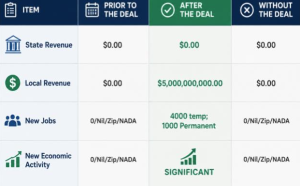
AWS in Madison, for example, is projected to pay over $5 billion in ad valorem taxes to Madison County over 30 years. That figure is conservative and will likely increase over time. AWS will probably evolve to be the state’s largest taxpayer – by far. In short, the State is conceding $1 to make $3. The following chart illustrates the net effect on taxpayers with and without the project.
Besides tax incentives, states – including Mississippi – often offer grants to attract projects. Grants are more problematic, depending on their specific nature and use. When those grants only provide benefit to the recipient, the State generally includes provisions in the grant agreement that claw back grant dollars provided if the business doesn’t fulfill its obligations as agreed. Obligations typically consist of capital investment and permanent jobs milestones by a certain date and for a specified period.
Using the AWS data center project as an example, Mississippi provided a total of $44 million in grants, of which ~$35 million will be used for workforce development. Even if AWS unplugged its servers and shuttered its complexes, the training provided to our workforce would endure and be leveraged for other jobs. No loss to taxpayers.
Loudoun County, Va. – known as Data Center Alley – recently reduced property taxes on homeowners by 30% over the last decade because of massive taxes paid by data center operators. Besides cutting taxes on residents, the county has built two new schools and a state-of-the-art recreation and aquatic facility.
In Richland Parish, Louisiana, teachers recently received a $50,000 bonus stemming from tax revenue produced by Meta’s AI data center.
There are currently seven data center sites across six Mississippi counties in various stages of development. Each of these counties is slated to receive significant real and personal property tax revenue once the facilities are online. Mississippi should consider enacting a measure that dedicates a portion of new property tax revenues produced by data centers to reducing taxes on homeowners and investing in quality-of-life assets Mississippi so desperately needs to attract and retain young workers. Perhaps some of the revenue could also be transferred to the Public Employees Retirement System (PERS), to reduce the fund’s massive $26 billion unfunded liability. The state could enact law that would allocate a small component of ad valorem revenue generated by data center projects over a specified amount to the counties other than the host county.
Concern: Data centers don’t create many jobs
Data centers themselves do not feature sprawling organizational charts relative to their physical footprint. Neither do farms. Automation and technology have made America’s farmers the most productive in the world. Yields have continuously increased while agricultural labor forces have shrunk.
While job creation from new industrial development is always important, data centers produce numerous other economic benefits that must be considered as part of the overall Data Center value proposition.
From a jobs perspective, while data centers don’t have large payrolls, their impact on the demand for labor is significant. Data center protesters often point to the thousands of jobs associated with construction of the giant buildings as “temporary.” That’s true, as virtually all construction jobs are temporary. It is estimated that nearly 1/3 of all construction workers in this country are currently involved in data center buildouts.
On average, electricians involved in data center construction earn $150,000 in annual wages. That’s more than 2x the median annual wage of $62,350 for standard electricians, according to the U.S. Bureau of Labor Statistics. The demand for electricians in data center hubs such as Texas and Virginia is so strong that annual wages for those qualified to work on high-voltage systems and uninterruptible power supplies (UPS) used by data centers have soared to $240,000 – $260,000.
Besides construction jobs and direct hires created by the data center boom, data centers are driving the creation of thousands of indirect jobs. From Caterpillar to Cisco, the domestic manufacturing sector is booming due to demand for everything from generators to network infrastructure, and that’s boosting sales of materials and components, such as steel and aluminum.
John Deere recently reported that its construction sales are surging, driven by data center projects. In Deere’s most recent earnings call, management indicated it expects demand from data center builders to increase 20% in the current fiscal year while agriculture sales decline 10%. The company is currently hiring for all roles across multiple locations.
Here in Mississippi, Jabil, a global manufacturer, recently announced an investment of $119 million in Marshall County. The company plans to renovate an existing 1.5 million-square-foot facility, where 2,200 workers will produce data center infrastructure, such as power distribution units (PDUs). It’s likely that Jabil sited this factory in Mississippi due to the data center projects under construction in the state. And there are other examples.
Think of data centers like roads and other transportation infrastructure. Both require a substantial number of jobs to construct, fewer to operate and maintain once complete. But whereas roads and bridges drive economic activity by facilitating the movement of goods and people, data centers move information and knowledge – fast. Next to human talent, information is an organization’s most precious asset. Data centers are the factories of the modern era. In May 2025, President Trump signed Executive Order # 14302, entitled Reinvigorating the Nuclear Industrial Base. The Order is designed to foster development of domestic nuclear power to meet America’s future energy needs – including the increase in electricity demand from data centers. Building nuclear power plants is a multi-year endeavor requiring
thousands of construction workers. Many must possess highly specialized skills that command lucrative compensation packages.
The job growth being driven by the AI revolution truly transcends the industry spectrum.
Concern: Data Centers are funded by closed-loop financing
Many financial experts and even some political figures have raised concerns about the interconnected funding schemes, known as “circular financing,” being used to underwrite data center projects. The question is whether this is of any concern to the state and/or the communities in which highly leveraged companies build data centers?
There is always risk in financing business activities with debt, because both the borrower and the lender are anticipating servicing the debt with future cash flows – and the future is never certain.
The state and local taxing government officials should certainly use care and conduct extensive financial due diligence on prospective data center projects – or projects related to any industry – before extending grants or tax incentives. But such due diligence, including provision of proprietary customer contracts, should not be a requirement for any sort of environmental permitting, as some politicians in Mississippi have proposed. That process should focus on environmental, not financial, matters – regardless of the nature of the industry and the specific development seeking a permit.
Many are skeptical about the future viability of the burgeoning artificial intelligence industry and the massive amount of capital investment (capex), much of which is leveraged by debt. Again, predicting the future is a fool’s errand, but all present indicators are looking good. The hyperscalers, chip manufacturers, and related companies are currently enjoying record demand, which is driving astronomical growth in both revenue and profit. We can take some comfort in the fact that many have a massive amount of cash on their balance sheets.
Even if AI fails to meet its promise, the data centers and IT infrastructure being deployed across America will still be needed and repurposed. But that’s a highly improbable scenario, given that AI is being embedded into virtually, well, everything. Often without the knowledge of the end-user. There has never been a time in history when society wanted less computing power, digital storage capacity, and clocked-down bandwidth. This historical trend is going to endure.
And if the AI-data center industry does totally crash, we’ve got much bigger problems, as that would be the result of a massive economic downturn. So, Mississippi’s choice is simple: reject and shun the New Renaissance that is artificial intelligence and quantum computing or welcome the industry – with reasonable guardrails.
Concern: Data Centers are “surveillance centers”
The belief that data centers are dedicated to hosting video surveillance technology and storing the video captured has been going viral of late. Americans are (rightfully) leery that their government, particularly local governments, are using video surveillance and license plate readers (LPR) to “spy” on citizens.
The vast majority of the consternation around video surveillance systems concerns automated license plate readers (ALPR) technology made by Flock Safety. There are over 120,000 Flock cameras and LPRs installed nationwide, including over 1,000 in Mississippi.
While citizens’ concerns about government tracking their movements are legitimate, the contention that data centers are primarily – if not exclusively – used for warrantless searches doesn’t stand up to financial scrutiny.
Flock is the largest provider of public safety cameras and automated license plate readers in the nation. Flock’s cloud hosting partner is Amazon Web Services (AWS). The company uses Amazon Web Services’ GovCloud infrastructure, data storage, KMS-based encryption (Key Management Service), security management, and compliance logging.
The company is on a revenue run-rate of $500 million for the current fiscal year. AWS’s FY 2026 revenue is trending at an annualized run-rate of $175 billion. If data centers were primarily purposed for video surveillance, a large component of AWS’s revenue would be derived from Flock Safety’s AWS subscription fees. If Flock Safety paid 100% of its revenue to AWS for services rendered, the subscription revenue received from Flock would equal less than 0.3% of AWS’s total annual revenue. Of course, Flock would not be a viable enterprise if it paid 100% of its revenue for cloud hosting services.
Over 5 million business customers worldwide are served by AWS’s massive global data center network. Flock is just one of them – and not a particularly large customer in terms of AWS cloud services utilized.
Every taxpayer in Mississippi has a “vested” interest in the success of the data center industry.
Most taxpayers in Mississippi likely aren’t aware that they have an equity position in companies that operate in the data center industry.
The Public Employees Retirement System (PERS) is a defined benefit program for Mississippi’s public sector employees. As of the end of Fiscal Year 2025, PERS’ membership consisted of 145,724 active employees and 122,226 retirees. Benefits are earned by vesting, which requires working a minimum of 8 years for an employer who participates in PERS. Members can retire with 30 years of service at any age or at age 60
and vested. While employed, the member contributes 9.0% of their earned compensation to the plan and their employer contributes 18.9%. Taxpayers not only pay the salaries for public sector workers, but they also pay the employers’ retirement contributions.
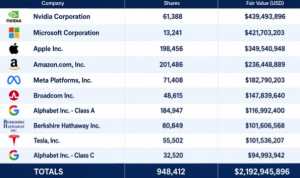
Employer and employee contributions are invested in a variety of securities, including stock in publicly traded companies. Thus, Mississippi taxpayers have an equity position (ownership) in numerous companies, including semiconductor manufacturers and hyperscale data center operators. The chart below is from PERS’ most recent annual report, showing that Mississippi taxpayers and PERS members have a combined investment of over $2.1 billion in semiconductor manufacturers and data center hyperscalers. These investments have performed exceedingly well and are critical to ensuring the program meets its benefit obligation to current and future retirees.
Taxpayers and members of PERS who oppose data centers are literally advocating against their own best financial interest. Any elected officials and candidates for office in Mississippi who oppose data centers or support a moratorium or outright ban of data centers are protesting the companies who represent a significant component of PERS’ equity investments. This past fiscal year, PERS enjoyed a banner ROI on the fund’s $35 billion+ portfolio, driven in large part by its technology holdings accounting for the fund’s top 10:
Earlier this year, the United States invested $2.013 billion in quantum computing companies to strengthen national security, build domestic quantum hardware supply chains, and ensure that America maintains technological leadership. These are direct grants provided to nine quantum companies and funded by taxpayers:
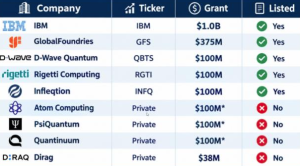
The bottom line is that both from a federal and a state taxpayer perspective, opposing AI and data centers is rooting against one’s own financial interest.
The Case for Building Data Centers – With Care
Construction of AI Factories (data centers) represents the greatest infrastructure build-out in American history. These massive investments across America are driving job growth, economic expansion, and tax revenue – and Mississippi is reaping the benefits.
Concerns expressed about data centers are genuine and should not be dismissed. But it’s important to parse the issues, taking care to separate fact from fiction. Instituting moratoriums, as many communities – including the City of Jackson – have done, is not the answer. Generally, such bans – even temporary – simply result in funneling contracts to crony “consultants” to study the issue. The only deliverable from these engagements is an expensive document supporting the prevailing position of the government body that authorized the contract.
Throughout history, new technology has drawn protests for a variety of reasons. In the early 19th century, textile workers destroyed automated weaving and knitting machines created
during the Industrial Revolution. The workers, dubbed Luddites after the mythical folk hero Ned Ludd, protested that the machines could take jobs, lower wages, and worsen working conditions.
Initially, the Luddites’ fears were realized as pay dropped sharply. But eventually, automation lowered the cost of production, expanded the textile market, and created new types of jobs, resulting in a huge net benefit to society. Technology is disruptive, often producing short-term pain which lays the foundation for long-term gain.
Hydraulic fracturing (fracking) is another example. Detractors protested the risk of groundwater contamination, massive water use, and wastewater discharge. Years after the fracking revolution launched, numerous studies show that fracking is safe, thanks to innovation and common-sense regulations. Imagine our country today without fracking, which accounts for roughly 65% of all crude oil produced in the United States.
This disruptive new technology lifecycle has been repeated numerous times throughout history. Data centers are the latest technological revolution drawing ire.
New York Governor Kathy Hochul signed an executive order in July 2026 that pauses issuance of permits to data centers. Thus far, the Empire State is the only state with a moratorium. Earlier this year, Micron Technology broke ground on a $100 billion (yes, with a “b”) semiconductor plant north of Syracuse, in Clay, New York. Micron, of course, makes memory and high-performance solid-state drives (SSDs) that are used in processors, servers, and storage devices installed in data centers.
Governor Hochul embraced a company whose customers supply the IT infrastructure that powers data centers. But she banned the company’s customers from setting up shop in her state. That’s rich.
Vermont Senator Bernie Sanders and Texas Representative Greg Casar have teamed up to introduce the “Ban Artificial Superintelligence Act.” Should this measure become law, all AI development in the United States would be suspended. Systems that have capabilities that equal or exceed human cognition will be banned. Violators could be sentenced to 20 years in prison. Think about that. The U.S. government would incarcerate a person for using their God-given intellectual talents to innovate and create solutions that serve society.
Scientists are currently working on a cure for cancer using AI. Others are using AI to help blind people see. Guess that’s not important to Bernie.
Ubiquitous and easy access to AI has significantly elevated the threat of cyberattacks. When you turn on your faucet or step into the shower, you expect water to flow. Just as powerful IT systems orchestrate our energy systems, so too do sophisticated computer
networks and software manage our public water infrastructure. This past July, seven states reported digital attacks on community water systems, 30 in Minnesota alone.
In September of 2023, Hinds County sustained a massive ransomware attack, forcing the shutdown of many county functions. It’s possible that had the attack been timed to coincide with a scheduled election, Hinds County voters would have been deprived of their ability to exercise their right at the polls. Concerns about election integrity are real and justified. But the true goal of our adversaries, such as China, is to render us unable to conduct elections through coordinated AI-powered cyberattacks on America’s 3,144 counties.
Quantum computing, when combined with AI (quantum AI), is expected to produce revolutionary benefits for society. America is in a race with China for quantum computing superiority, just as we are competing for the edge in artificial intelligence. We have the lead now, but if we cede the quantum AI high ground to China, the Chinese Communist Party could easily decrypt the modern digital security systems used to protect our most critical assets and industries. Should our most ardent foe eclipse our capability in frontier technologies, we could suffer total economic collapse without a single shot being fired.
Thus, quantum computing and AI are essential to our national security. The only way to mitigate malicious digital AI/quantum threats is to stay ahead with more advanced AI/quantum cyber protection technology. And that requires data centers.
Fortunately, President Trump recognizes the critical importance of both artificial intelligence and quantum computing to our national security and economic future. That’s why the president has been fervent in his support for the nation’s data center build-out – with reasonable community safeguards. The president has issued ten executive orders related to AI, including Promoting Advanced Artificial Intelligence Innovation and Security, Ensuring a National Policy Framework for Artificial Intelligence and Unlocking Cures for Pediatric Cancer with Artificial Intelligence.
Recently, the Commander-in-Chief lauded AI data centers as economic “cash cows” and “money machines” that drive massive investments, local tax bases, and jobs. In late August, he wrote in a Truth Social Post, “The only reason that communities throughout the U.S.A. should not want Data Centers is if they want to end up being backwards and poor. If they want to be successful and rich, with far lower taxes and jobs all over the place, let Data Reign.”
Conclusion
Dubbed “The Mississippi Miracle” by the New York Times, the Magnolia State’s stunning gains in public education are setting the standard across the nation. However, Governor
Tate Reeves routinely indicates that our educational achievements are not a miracle. Common sense policy laid the groundwork; Mississippi’s families and educators delivered the results.
Just as the nation is curious about our formula that improved K-12 education, so, too, are other states – and even the world – watching how Mississippi develops its data center industry.
Artificial intelligence and quantum computing are transformational technologies that are ushering in a new renaissance, and data centers are their lifeblood.
President Trump published an AI strategy document in 2025 emphasizing the need to fast-track the infrastructure necessary to support AI and Quantum Computing and strengthen cybersecurity. Mississippi is answering the nation’s call to support our technology needs while safeguarding our environment, preserving our precious farmland and water, and protecting the quality of life in our communities.
Our state is commissioning, constructing, provisioning, and regulating data centers in a thoughtful, responsible, ethical, and safe manner.
While no data centers should ever be built without local approval and community support, local authorities should recognize that the data center train has departed, and it’s rapidly gaining speed. Will Mississippi hop on board for this once-in-a-generation opportunity, or will we be left behind at the station?
The views expressed by contributors are their own and not the views of SuperTalk Mississippi Media.