



Debate over a Republican-led omnibus education package lasted for more than four hours in the Mississippi House on Thursday. But Republicans, who hold a supermajority in the chamber and had wiggle room to lose some votes, managed to advance the bill in a narrow 60-58 vote.
All Democrats opposed House Bill 2, authored by Republican Speaker Jason White and dubbed the “Mississippi Education Freedom Act.” Those within White’s party who voted against the measure were Reps. Richard Bennett, Andy Boyd, Billy Calvert, Becky Currie, Jill Ford, Greg Haney, Stacey Hobgood-Wilkes, Missy McGee, Dana McLean, Gene Newman, Fred Shanks, Troy Smith, and Lance Varner.

HB 2 was amended in committee discussions on Wednesday to remove any language related to the state’s current public school funding formula, which both House and Senate leaders have publicly said they plan to fully fund for a third year in a row. Cornerstones of the package are allowing the use of public-school money on private schools, changing the process for public-school students who want to transfer to another public school, and expanding charter options.
White is a longtime advocate for school choice, the idea of giving parents more of a say in where their children are educated without being restricted by their zipcode, said in a statement after the vote that the bill is “about what is best for children and future generations.”
“I am incredibly proud of the House members who stood up for kids and families in Mississippi. With more than four hours of debate, I commend both sides of the aisle for civil discussion,” the statement reads in part. “The Mississippi Education Freedom Act is about what is best for children and future generations.

The wide-net legislation would create Magnolia Student Accounts, or access to stipends of up to or around $7,000 that can be used on private-school tuition. The phase-in program would begin in the 2027-28 school year and have 12,500 scholarships available in year one, with low- and middle-income students prioritized. 20,000 scholarships would be available in the program’s fourth year. The State Treasurer’s Office would be responsible for administering the accounts.
It would take away the home district’s veto power in cases of students wanting to transfer to another public school. Under existing law, a student who wants to transfer to another school must receive approval from both the home and receiving districts, something that rarely happens since per-student money allocated to schools leaves with them.
Other measures included in the now-427-page bill include allowing charter schools to open in districts that have at least one D- or F-rated school. Currently, Mississippi only allows charter schools to open without local school board approval if the entire district is rated a D or F; allowing home-schooled students to participate in public-school extracurriculars such as clubs and athletics; expanding targeted literacy and math initiatives; allowing school boards to designate time for student-led, voluntary prayer; establishing a pilot program to expand Junior Reserve Officer Training Corps programs through grant assistance; and consolidating the Copiah County and Hazlehurst school districts.
Even with ringing endorsements from Republicans nationally, including U.S. Education Secretary Linda McMahon, some GOP representatives voted against the measure with constituent concerns in mind. Republicans like Ford and Shanks, who represent portions of Madison and Rankin counties, voted against the measure. A-rated school systems and citizens within each of their districts have raised concerns over school choice.
“I want to commend the House on a very civil debate over a very divisive topic, but after many talks with parents, teachers, and administrators, I chose to vote with the people of Rankin County,” Shanks said.
Democrats were in unison against HB 2, proposing several failed amendments while citing concerns such as money leaving public schools when students decide to transfer – a point Rep. Jansen Owen, a Republican from Hattiesburg and co-author of the bill, countered only creates “competition and incentive to improve.”
House Minority Leader Robert Johnson III, a Democrat from Natchez who raised his concerns on the floor, said last week that he was concerned it “won’t actually provide the kinds of opportunity and equitable access to education that it should.” As it relates to the public-to-public transfer component, he believes the receiving school should not be able to veto a student’s transfer request.
“If pure school choice means, I don’t care where I live, I can choose to go to a school that I think serves my needs or serves my child’s needs, the only way that works is that if I choose to go there, that school cannot say no to me. I don’t care if I’m a D or F student…if that’s what I think works for me, you cannot turn me down,” Johnson said. “But there has not been a provision that provides that kind of access.”
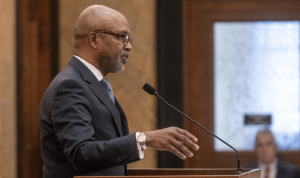
Johnson added that ancillary costs, such as transporting students, are not adequately addressed. The bill says the receiving school district can provide transportation, but is not required to, meaning the responsibility would fall to a parent or lead guardian.
Rep. Jeffrey Hulum III, a Democrat from Gulfport who’s running for Congress, argued that some superintendents on the Coast are against school choice, and if Republicans are trying to implement it with parents in mind, they should put it on the ballot for a vote.
“I think the ability for a parent to choose the school right now, with this bill that we have, is [voting] with your feet. That’s my position, so that’s where I’m at with this. You vote with your feet,” House Education Chair Rob Roberson responded to that idea, saying that parents who choose or don’t choose to move their students to another school are voicing their preferences through their decisions.
HB 2 would also raise the minimum base salary for assistant teachers from $17,000 to $20,000 while making it easier for retired teachers to return to the classroom without jeopardizing pension benefits.
High school transfer portal concerns
As the transfer portal in college athletics only gets bigger and harder to tame, some lawmakers are worried HB 2 may bring with it some form of a portal to high school athletics. It includes the measure that removes the home district’s veto power when students want to transfer to another public school and gives way for homeschooled students to participate in public-school sports.
Hulum said during his floor speech that a representative from the Mississippi High School Activities Association told lawmakers during a summer meeting that changes within the bill would “erode high school sports.”
As for the eligibility of student-athletes transferring from another public school, the bill leaves it up to the MHSAA to determine the eligibility of student-athletes.
The MHSAA did not immediately respond to a request for comment.
Not much appetite in the Senate
While HB 2 may have cleared the House, it’s expected to hit a wall in the Senate. Even if it makes it out of committee, the version of the package as currently written is destined to look completely different after the Senate takes a pen to it.
The Senate, which passed a bill last week to remove the veto power from home districts when students want to transfer to another public school, has education leaders who have made it clear that they’re stopping there.
“This is as far as we’re willing to go. I’m not in favor of vouchers,” Senate Education Chair Dennis DeBar, a Republican from Leakesville, said after the vote and in regard to public money being used for private-school tuition.
It is worth noting that Republican Gov. Tate Reeves has voiced his support of HB 2, but his power over lawmakers is constitutionally limited, meaning in this case, he can only recommend that lawmakers vote one way or another.
Constitutional concerns
Ahead of the Senate receiving HB 2, DeBar raised concerns over the constitutionality of public money going toward private-school tuition.
“Section 208 of our Mississippi Constitution says no public funds shall be appropriated to non-public schools,” DeBar said on Wednesday. “So, what I think the House has done is they’ve put the cart before the horse. I think we need to clarify the constitutional issue on that, because if we pass vouchers this year, you know, there are going to be lawsuits.”
Section 208 of the Mississippi Constitution reads that public funds cannot be “appropriated toward the support of any sectarian school, or to any school that at the time of receiving such appropriation is not conducted as a free school,” something Speaker White reads differently than DeBar. White argues that HB 2 does not send money directly to private schools, rather it’s opened to the taxpayers for use at private schools.
“We’re not talking about sending money to schools,” White said before Thursday’s vote. “We’re talking about giving parents some of their tax dollars they’ve paid back.
“These are precious public dollars that most people seem to forget are actually taxpayers’ money. It didn’t fall from the sky. It didn’t go through a laundry machine and become the state’s. It’s people’s money. We’re simply holding it and trying to spend it on priorities that people have come to expect or want from their government…and one of the things they’re starting to expect is some say in how their education dollars are spent.”
White added that if the Senate’s position is hinged on the state’s constitution, it should introduce bills to change other programs that see funds allocated to private institutions, organizations, and nonprofits.
“If that is their position, they need to be drafting bills to repeal how we do current ESAs, the way we do Pell grants and send money to go to college at private institutions. They need to redo everything we do from the SNAP program to MDOT,” he said. “We send money to all sorts of private institutions that have different specs, guidelines, or none compared to if we do that internally through a state agency.”