



If you walked outside last month and said, “It feels hotter than usual,” you weren’t wrong. In fact, it was the hottest July on record for the contiguous United States.
The National Oceanic and Atmospheric Administration released its July 2026 temperature and precipitation assessment Monday, noting that more than half of Mississippi saw temperatures “much above average” during the month. The northeastern tip of the state saw “above average” temperatures.

The assessment comes as Mississippi dealt with sweltering temperatures and plenty of days when heat index readings climbed well above 100 degrees Fahrenheit.
Nationally, July averaged 76.89 degrees across the contiguous United States, NOAA said. That eclipsed the previous record set during the Dust Bowl in July 1936 by an eighth of a degree. Records date to 1895.
The heat was so widespread that every one of the Lower 48 states was at least 1 degree warmer than its 20th-century average, said Russ Vose, chief of monitoring at NOAA’s National Centers for Environmental Information.
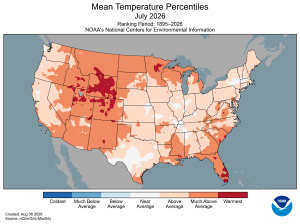
Vose said the heat during the Dust Bowl years was more concentrated in parts of the Midwest and was exacerbated by agricultural practices at the time. That makes July 2026 particularly notable, with all 48 contiguous states recording temperatures above their 20th-century averages.
Daytime maximum temperatures averaged 89.5 degrees nationally, 2.9 degrees above average, ranking July as the sixth-warmest month on record for average high temperatures. Overnight minimum temperatures averaged 64.2 degrees, 3.7 degrees above average, making July the warmest month on record for average low temperatures and surpassing July 2022.
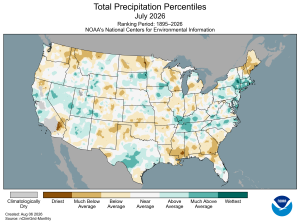
As for precipitation, very little of Mississippi reached its average rainfall for July. Part of northeast Mississippi, which saw the state’s “coolest” temperatures, received an “above average” amount of rain. Some parts of north-central Mississippi were “near average,” while the rest of the state was below average in rainfall.
The Pine Belt and Gulf Coast regions, as well as a small pocket of the Delta, received rainfall totals that were “much below average.”
Whether summer 2026 will go down as the hottest summer on record is still unknown. The summers of 2021 and 1936 are tied as the hottest on record in the United States, with summer defined by NOAA as June through August. Through July, 2026 is slightly cooler than 2021, which was driven by record heat in June.
The Associated Press contributed to this report.