


The Mississippi Department of Transportation will soon undergo one of the largest projects in its history to improve roads and bridges on two major interstates in the Jackson metro.
Dubbed “The Big Fix” by transportation officials, the I-20/I-55 Freight Corridors Improvement Project is a $400 million initiative aimed at repairing and upgrading 36 bridges and 121 lane miles. The plan includes improving 16 miles on both the east and westbound sides, totaling 32 miles, but when put together with all lanes, that number is 121. Construction is set to begin in September 2026 with hopes of a late 2028 or early 2029 completion date.

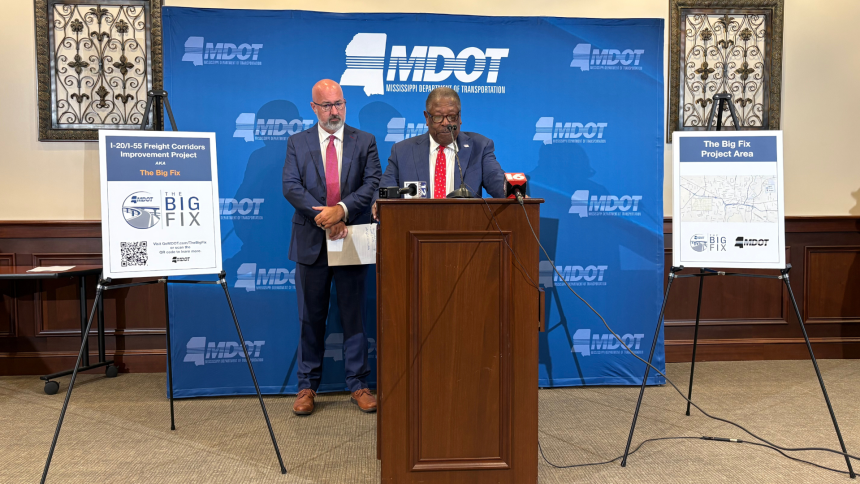
“This transformative initiative will modernize some of the state’s most heavily-traveled corridors, enhancing safety, improving mobility and extending the life of many interstate bridges throughout the Jackson-metro,” MDOT Commission Chairman Willie Simmons said. “The Big Fix represents a comprehensive investment in central Mississippi’s network, focusing on the busy I-20/I-55 routes that have served as vital arteries for commuters, commercial traffic and freight movement for over 60 years.”
Construction will take place between Wiggins Road and Pearson Road on I-20, between McDowell Road and just north of High Street on I-55, between I-20 and the Lynch St. bridge on I-220, and from I-55 to the end of state maintenance north of U.S. 80 on U.S. 51.
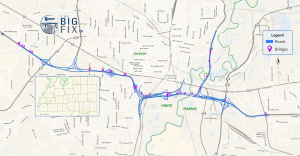
Construction will focus on repaving and rehabilitating the pavement, removing and replacing guardrails and concrete, and widening the shoulders on both interstates. According to MDOT, these sections of I-20 and I-55 are decades old, and they plan to bring them up to date.
“This section of interstate was built to 1960s standards, which puts them behind,” MDOT Executive Director Brad White said. “This will bring them up to today’s standards. Wider shoulders, more efficient roadways, to help not just emergency vehicles, but also the daily commuters that go through the area.”
Beyond the road and bridge repairs, MDOT is also deploying intelligent transportation systems to improve traffic management and real-time communication to drivers in the area. This includes new and upgraded cameras and other technology-based quality-of-life improvements for drivers such as new and improved mounted digital message signs.
According to White, the project will take roughly two and a half years to complete with intermittent closures.
“The start date will begin in September 2026, with nighttime and single-double lane closures starting in October of this year,” White explained. “There will be two periods of time when the interstate will be shut down in its totality in one direction at a time. The first shutdown will be a 45-day full closure on I-20 westbound; full closure is expected in the summer of 2027. The second full shutdown will be a 45-day on I-20 eastbound, with the full closure expected the following year, in the summer of 2028.”
White stated that the specific detours will be posted to MDOT’s website when the time comes so that residents will be properly notified on a consistent basis, but White did confirm that traffic will detour around the full shutdowns via I-55, I-220, and Highway 80.
“When we do the closing, we’re only closing in one direction, and we’re going to schedule those closings so they fall on the summer months and not around things such as the state fair and other heavy activity areas,” Simmons said.
Simmons emphasized that MDOT’s decision to use full lane closures and a constant construction schedule is to speed up the process rather than drag it out longer than necessary.
“We would upset the traffic flow as well as the local community if we broke it up into phases and did two miles at a time or one interchange to another,” Simmons said. “That means each time we’d do it, we’d want to get to slow down traffic or a closure, and we’d come back six months or a year later and have to do another phase. … This was the best way we could do it to get it done and get it done in a much faster time. We’ve cut the time in half.”
With prices and construction costs remaining high, White said MDOT chose to start on The Big Fix sooner rather than later to save the department money down the road.
“By doing the project this way, we’re turning a project that would’ve otherwise taken decades, into one that can be done in a two and a half year period of time,” White said. “In addition to that, we’re getting everything in today’s dollars before the price of everything continues to go up.”
The public is encouraged to stay looped in on The Big Fix progress, lane closures and travel impacts on a new website page dedicated to the project. You can also get real-time traffic conditions across Mississippi by downloading the MDOT Traffic mobile app, visiting MDOT’s website, and following MDOT’s social media channels.