


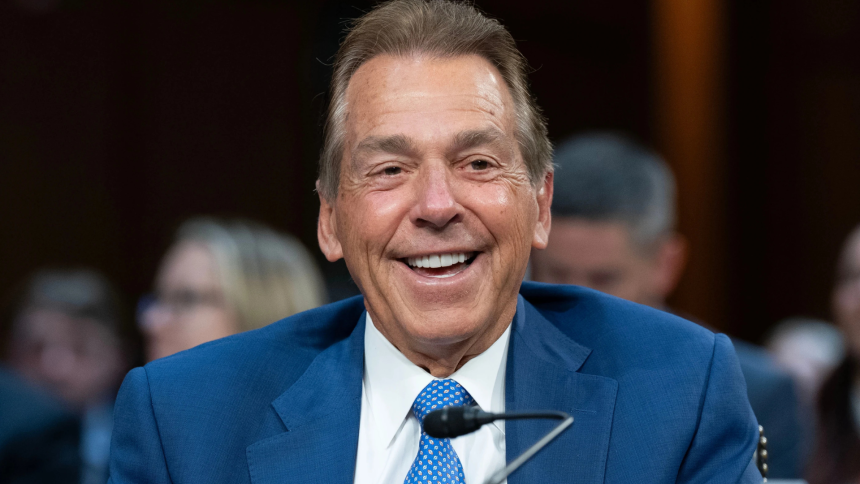
Ole Miss was fresh on the mind of former college football king Nick Saban during a congressional hearing in the nation’s capitol on Wednesday.
While advocating for the Save College Sports Act, a bipartisan measure authored by U.S. Sens. Ted Cruz (R-Texas) and Maria Cantwell (D-Wash.) aimed at establishing a national framework for college athletics amid ever-growing NIL deals and virtually endless transfers, Saban took two not-so-subtle jabs at Ole Miss.

Saban, a seven-time national champion as a head coach, contended that, in the modern era of college sports, players have agents who can practically communicate with staffers from any school unchecked. He also pointed to tampering running rampant in football, pointing to how linebacker Luke Ferrelli recently made it to Oxford.
“We have nothing to control agents and we have nothing to control tampering,” Saban said. “Clemson had a player that was on campus for a whole week and [Ole Miss] came and got him off the campus and took him some place else.”
Ferrelli, the 2025 ACC Defensive Rookie of the Year, transferred to Clemson and signed a revenue-sharing deal with the Tigers after spending his freshman season at California.
He had been recruited by Ole Miss during the January transfer portal window. After Ferrelli enrolled in classes at Clemson, TJ Dottery hit the portal and followed ex-Rebel head coach Lane Kiffin to LSU – leaving the Rebels in need of a linebacker.
During a January press conference, Clemson head coach Dabo Swinney accused Pete Golding, a former Saban assistant at Alabama, and staffers aggressively pursued Ferrelli, so much so that they “clearly” violated tampering rules.
Golding is said to have sent the linebacker a picture of $1 million contract, while coercing Ole Miss quarterback Trinidad Chambliss and New York Giants signal-caller Jaxson Dart reach out to Ferrelli to lure him to Oxford. Ferrelli ultimately re-entered the portal and is currently listed on the Rebels’ football roster, though the NCAA has launched a probe into Ole Miss over the matter.
Another shot Saban took at Ole Miss centered on the successful quest Chambliss, the quarterback’s legal team, and the university’s athletics department embarked on to get the star field general an additional year of eligibility. Saban argued that the NCAA has no enforcement of its rules, asserting that student-athletes like Chambliss have found a loophole in favorable state courtrooms.
“Right now in college football, we have no rules. We have state laws [that are] different in every state. We have litigation. The NCAA cannot enforce their own rules because every time they try to enforce the rules, there’s a lawsuit,” Saban said. “An example would be Ole Miss’ quarterback. They say he can’t play next year. He’s playing next year because of litigation.”
A months-long back-and-forth involving a waiver request being denied three times, a court hearing that resulted in the NCAA’s decision being superseded, and a last-ditch effort by college athletics’ governing body to have Mississippi’s Supreme Court intervene in the case came to a close with Chambliss ultimately being cleared to suit up in the 2026-27 campaign.
Though Saban and other prominent college sports leadership figures were passionate in espousing a need for Congress to intervene, it is not expected that federal lawmakers will pass the Save College Sports Act and send it to President Donald Trump.