


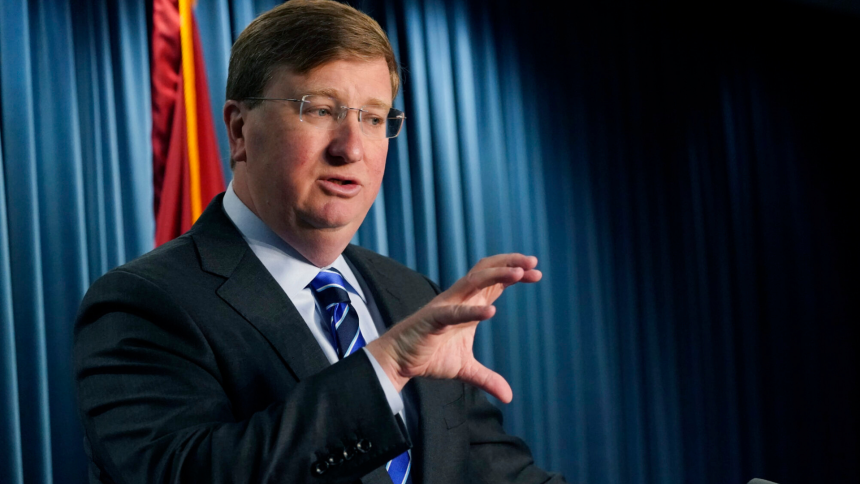
The motive behind a veto from Gov. Tate Reeves on a disaster relief bill has sparked a public clash among some of Mississippi’s top political leaders, with accusations ranging from misinformation to potentially criminal conduct.
Reeves, a Republican in his sixth year as governor, vetoed Senate Bill 2632 late Monday. The legislation would have created a state-run loan program to help cities and counties recover from damage caused by Winter Storm Fern. The storm hit in late January, impacting over half the state, and is widely considered Mississippi’s most severe winter weather event since 1994.

The proposed program was to be administered by the Mississippi Emergency Management Agency and provide short-term loans to local governments after federal emergency relief is provided to the state. Under the bill Reeves vetoed, those loans would carry a 1% annual interest rate.
In his veto message, Reeves argued the version of the bill that reached his desk was “materially different” from what lawmakers had agreed upon. He claimed he had negotiated a 1% monthly interest rate – or what would even out at 12% annually – and alleged that someone altered the final language of the bill after legislative approval.
“Let me be clear, there is no provision contained in either the Constitution or any statute that authorizes the Senate Clerk’s Office (or any person or persons involved) to make a material change to the language of a conference report,” Reeves wrote. He went on to call the alleged change “plainly unconstitutional” and “possibly criminal.” Legislative leaders quickly pushed back, disputing both the governor’s timeline and his characterization of events.
According to lawmakers, the inclusion of the word “monthly” in earlier versions of the bill was a clerical error that would have resulted in a 12% annual interest rate – far higher than intended. They said the Senate unanimously approved a correction removing that language before the bill was finalized and sent to Reeves.

Republican Lt. Gov. Delbert Hosemann accused the governor of misrepresenting the process and unfairly targeting lawmakers and legislative staffers. Reeves originally blamed Democratic Sen. Hob Bryan, saying the amendment was made on March 17, but Hosemann said the amendment was made on March 13 by Republican Sen. Tyler McCaughn.
“The Governor’s veto message is inaccurate,” Hosemann stated. “On March 13, Senator Tyler McCaughn asked for unanimous consent to remove the word ‘monthly’ as reflected in the Legislature’s YouTube recording at the 33:45 mark. Senator Bryan’s motion on March 17 pertained to a different bill, HB 895, not SB 2632 as the Governor’s veto message falsely claims.”
“Attacking and accusing a Senate staffer of committing a criminal act in a veto message is malicious, unnecessary, and false,” Hosemann added.

McCaughn echoed that sentiment on the Senate floor Tuesday, directly addressing the governor’s allegations and defending the chamber’s actions.
“To say that the actions of this body – this professional body – are criminal is beyond reproach to me,” McCaughn said. “I’m offended that anybody would accuse our staff or any member of doing something at that level.”
He added that it is “easy to see” he is not Bryan, but he has “respect” for his Democratic colleague.
Reeves’ deputy chief of staff, Cory Custer, backed the governor’s decision, writing in a text message to SuperTalk Mississippi News: “If the House and Senate send the Governor the exact same bill 174 members had the opportunity to vote on, he will gladly sign it. He told the Lieutenant Governor and Speaker that yesterday.”
It remains unclear if Reeves is personally advocating for a 12% loan for storm victims.
Lawmakers can now override the veto with a two-thirds majority if they choose to do so. In the case of SB 2632 – which passed both chambers unanimously – lawmakers seem to have enough votes to make the rare move.