


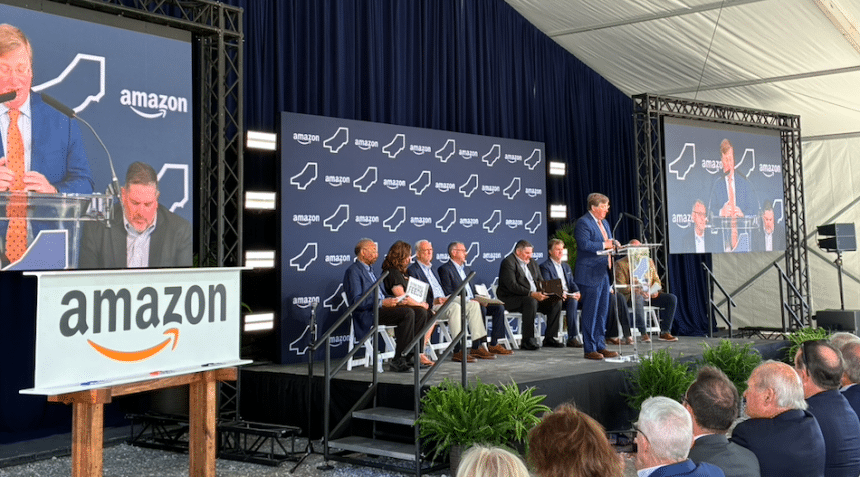
Two years ago, Amazon Web Services broke ground on a $10 billion-plus data center project in Madison County. On Thursday, that investment more than doubled with the company committing an additional $12 billion to build a bigger presence in Mississippi.
Officials gathered in Ridgeland, where Amazon is building one of its two major data centers in the county, to announce where the new investment will go. Gov. Tate Reeves took the podium and outlined that $11 billion will go toward extending operations in Ridgeland, while the remaining $1 billion will be used to establish a data center presence in Clinton.

“In Mississippi, we understand the single most important thing about economic development, and that is that economic development is a team sport. In Mississippi, we have the best team in all of America,” Reeves said. “As all of you who have been in this process know, data centers are not just buildings. They are literally the backbone of the digital economy. They’re being built and powered by us, America’s ‘digital delta.’ Make no mistake, other states are taking notice of the special things happening here in Mississippi.”
The Ridgeland expansion is expected to create 700 new jobs. In Clinton, Amazon is taking over the former Delphi Corporation plant, where 100 new jobs will be created. With these investments, the company boasts that its total planned capital investment in the state is $25 billion and that it expects to create more than 2,000 jobs when all projects are completed. Amazon is also working to establish a data center presence in Vicksburg, in addition to its Madison County and Clinton projects.
In the meantime, construction jobs by the thousands are being filled by Mississippi companies and residents to build these data centers. Beyond the overarching impact the facilities are expected to have on the state long term, officials estimate that the construction phase alone will bring more than $30 million in hotel and restaurant spending to the local economies supporting these projects.
“What I’m most proud of is that the men and women of these construction companies have shown up every day for the last two years and worked hard. Many of them are Mississippi companies and Mississippi workers using Mississippi hands,” Madison County Economic Development Association Executive Director Joey Deason said.
“The contractors who broke ground and haven’t slowed down since to make this project a reality … the vendors, the suppliers, the electricians, the engineers who stepped up and said, ‘We can do that,’ and they made it happen. Y’all didn’t just support this project, you’re a very large part of this project of who this project is, and Amazon noticed.”
Water and utility bill concerns
Data centers face intense scrutiny nationwide over the amount of water they require for cooling. Some estimations suggest that large facilities use up to 5 million gallons daily, or the equivalent amount consumed by the entire towns of Ridgeland, Canton, and Clinton. Protestors nationwide have voiced concerns over lower water pressure in their homes, decreased groundwater levels, and even possible contamination due to the chemicals the cooling devices at data centers use.
Aiming to squash those concerns, Amazon Web Services Vice President of Economic Development Roger Wehner announced the projects in Mississippi would be water-friendly. He said the company is committed to being a good steward of the state’s natural resources.
“We try to keep our word. Every step of the way, Mississippi has been there for us. They’ve been ready,” Wehner said. “You’ve built the infrastructure. You’ve developed the workforce. You’ve made us feel welcome and at home. You had faith in us when, candidly, there wasn’t really a lot. We don’t take that lightly. We’re super appreciative of that.”
In Clinton, no water will be used at the Amazon data center, and in Canton, the water used for cooling will be recycled, per Wehner. In Ridgeland, water will only be used for 9% of the year, or roughly 33 days, he said.
Other concerns stem from the idea that data centers’ large power consumption will result in utility bills skyrocketing. In a state like Mississippi, where poverty is prevalent, any rate increase takes a heavy toll on a large sector of the population. Attempting to alleviate any worry of bill hikes, Entergy Mississippi President and CEO Haley Fisackerly said Amazon’s presence will have the opposite effect on rates.
Entergy announced in March that customers in Mississippi will save more than $2 billion on power bills due to data center projects in its service range. Efforts by the state legislature, Gov. Reeves, and the Mississippi Public Service Commission paved the way for large companies, like Amazon, to cover the cost for grid upgrades and other ancillary increases in the cost of powering homes and businesses to avoid putting that burden on the individual ratepayer.
“Amazon is giving us a lifeline. We were faced with the fact that we have a slow growth state, where a large portion of our customers live under the national poverty level, and we have to keep affordability in mind. But at the same time, we all depend on this grid, and we’re dealing with more adverse weather conditions,” Fisackerly said. “We wanted to invest badly, but how do you do that and maintain affordability. By bringing Amazon in — they’re a large customer. They share a greater portion of the cost, and it actually creates benefits for our customers.”
Beyond the data centers
Beyond the work being done to build the data centers, Amazon’s investment is serving an educational purpose. The company is launching four “Think Big” corners in Canton public schools aimed at providing spaces for students to engage in science, technology, engineering, and mathematics (STEM) learning.
Amazon is also implementing its “We Build it Better” campaign in central Mississippi to offer quality STEM education to 10,000 students across public schools in Jackson, Canton, Vicksburg, and all of Madison County. The company has worked with Mississippi’s community colleges and universities, as well. Specifically, a free Amazon-backed apprenticeship program at Hinds and Holmes community colleges that has yielded a 70% employment rate.
“Think about that number,” Wehner said. “Seven out of 10 folks who go through that program immediately move into a job.”
To date, Wehner said more than 6,500 Mississippians have been trained for careers in data centers. Amazon has looked to add to that tally with mobile training centers that have reached more than 700 people at over 40 events.
“These are Mississippians from your communities. We’re talking about Greenville, down to Vicksburg, to Jackson, to Natchez, over to Grenada, even. These are people from all over the place,” Accelerate MS Executive Director Dr. Courtney Taylor said. “All of these programs are possible because of really deep partnership.”
Taylor added that the state of Mississippi has collaborated with Amazon through a $9 million artificial intelligence-focused talent accelerator program that is currently underway at many of the state’s higher learning institutions. Mississippi will soon launch a $6 million “Constructing Futures” program to train K-12 and community college students for information infrastructure jobs, like ones at Amazon.
Charitable impact
Officials touted the charitable role Amazon is playing in Mississippi as part of its investment in local communities. Martha Allen Price, who heads nonprofit food bank Extra Table, announced that Amazon is stepping up to serve hungry Mississippians. The company has committed to making 17 deliveries to the nonprofit’s 66 food pantries free of charge.
“When we are able to save money, more Mississippians receive meals,” Price said.