



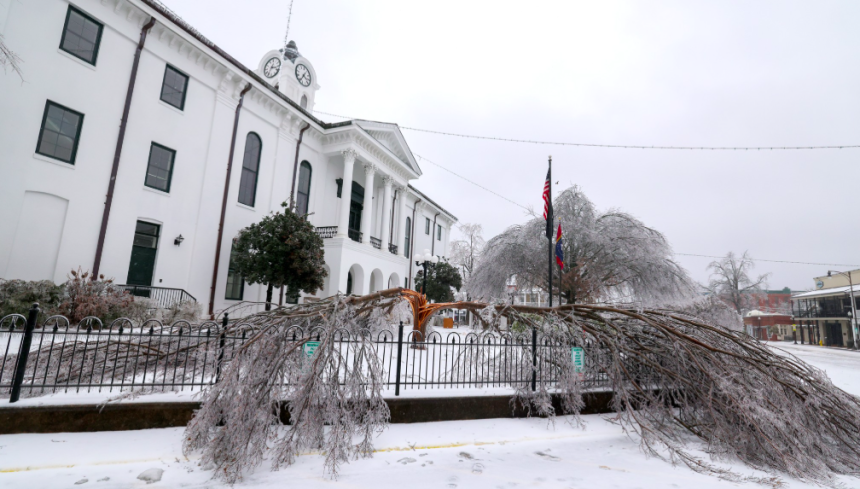
A full-force preparation plan put together and carried out by state and local governments and so far heeded by citizens has resulted in “no reported fatalities or injuries” amid dangerous conditions brought to Mississippi by Winter Storm Fern, Gov. Tate Reeves said during a press conference Sunday afternoon.
Reeves was joined by Mississippi Emergency Management Agency executive director Stephen McCraney and Mississippi Department of Transportation executive director Brad White in Jackson as the state officials provided an update on a weekend full of significant icing and other elements in over half the state. While the trio noted that challenges remain with below-freezing temperatures expected well into the week and over 160,000 residents still without power, they said Mississippi was more prepared than ever for a winter event of Fern’s caliber.

“I will take this opportunity to brag on the men and women who make up the Mississippi Department of Transportation maintenance forces. I feel like our people were very well prepared for this storm beginning earlier in the week by putting out a record number of materials to pretreat the roadways and bridges and try to do the best we could to get ahead of what Mother Nature was going to bring,” White said, noting the MDOT used over 200,000 gallons of brine, salt, sand, and other materials to pretreat roads while responding accordingly throughout the weekend to clear roads.
Additional preparation efforts made by MDOT, MEMA, and other state agencies included the issuance of public travel advisories and weather safety tips, working in tandem with local agencies such as city and county emergency management offices, and ensuring warming shelters would be open statewide. The state has mobilized resources such as generators, bottled waters, and food to impacted areas throughout the weekend.
Still, even with Fern’s passing and the days of preparation efforts and subsequent response, the storm’s impacts are not over. Reeves, McCraney, and White said that with ice being reported in 37 counties and rain in 10 more, a cold snap left behind is set to drop lows statewide below freezing. Those temperatures are going to make it hard for existing ice to melt while creating new ice in different parts of the state.
“We get ready for it, but then we just don’t know how bad the ice is going to be. We’re looking at almost [two days] for Mother Nature to come back and melt it down,” McCraney said, urging people in impacted areas to not drive over the next couple of days if at all possible. “We need you to hold stead, stay at home.”
Reeves commended Mississippians for staying off the roads for the better part of the weekend, allowing state agencies and emergency officials to travel easier. While ice totals have yet to be confirmed by the National Weather Service, the governor said it is the worst ice storm Mississippi has seen since December 1994 when three to six inches of accumulation was seen in places.
“We haven’t seen a storm of this magnitude since 1994. Again, I do want to commend my fellow Mississippians. We have been fortunate that most people have stayed off the road,” he said.
Even when roads are drivable, restoring power may take more than a couple days in certain places – especially in Tippah County, where thousands of residents could be without power for weeks. McCraney said getting power back on is front of mind for his agency, which is working with FEMA after President Donald Trump approved a federal emergency declaration in Mississippi on Saturday. Reeves said he’s been in contact with “the CEOs of most of the utility companies” to work together to get the lights back on.
“We could have roads that are passable in 48 hours, but we still don’t have power,” McCraney said. “We’re still going to have to have heating stations, and once those roads get open, then you have a bigger machine that’s going to come up. FEMA has started sending assets to us, and we’re going to put those in the most vulnerable places on time and in place to be able to carry this out.”
In addition to the widespread outages, parts of Mississippi like Oxford – where early counts show between one to two inches of ice – had power lines come down, street lamps damaged, and trees fall. Everywhere from the southwest corner of the Mississippi River northeast to where the Tennessee and Alabama lines meet and north of that line saw some sort of impact from the weather.