



Legislation requiring public schools in Mississippi to teach students how the government works cruised through the state Senate with unanimous support.
Both Republicans and Democrats in the chamber voted to send Senate Bill 2292 across the capitol to the House of Representatives for consideration. The measure fulfilled a pre-session promise by Sen. Brice Wiggins, R-Pascagoula, to continue advocating for civics to be a mandatory course for high school graduation. The bill not only does that, but it also requires schools to teach civics as a standalone course from the eighth-grade level up to a pupil’s senior year.

Wiggins introduced a similar measure last year, and while it passed in its originating chamber, it did not go to a floor vote in the House. Hoping that changes this time around, he said his motivation for the bill stemmed from what he believes to be a basic illiteracy of the American government structure that has been magnified on social media.
“You can go on social media, and you can see people’s comments, and you realize they don’t understand civics or how government works,” Wiggins said on Mornings with Richard Cross. “People think the executive branch makes the laws. They don’t. Congress, the legislature, makes the laws. The judiciary doesn’t make the laws.”
The civics curriculum, according to the bill, would serve to teach the history, heritage, and civic life of the United States and the state of Mississippi. Pupils would learn more about the U.S. Constitution and basic principles of democracy, including the duties of each branch of the federal government, along with the separation of powers. An emphasis would also be placed on how government works at the local level.
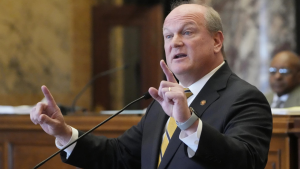
“We have to be informed citizens. This is government for the people, by the people, and of the people. But that requires us to be informed citizens,” Wiggins added. “For whatever reason, it’s not being taught. I heard some people say, ‘Well, we have government [classes].’ Well, civics is different than government. This is about checks and balances. This is about the separation of powers. This is about federalism.”
Federalism, a form of government that highlights where power is divided from the federal ranks to the state and down to the local level, would be a major focal point of civics courses, one Wiggins is eager for pupils to learn more about.
“If you know the 10th Amendment, which most people don’t know the 10th Amendment, things are reserved to the states. People think the answer is to go to the federal government to get something done. That is not how our founders set it up,” Wiggins said. “The federal government is basically a government of last resort. It’s left to the people and the states, and that is not being taught.”
To Wiggins, emphasizing the importance of the role local lawmakers play and how decisions made at the city, county, and state level impact the every day lives of citizens could boost voter turnout, where Mississippi has struggled in non-presidential and gubernatorial elections. Instead of party primaries essentially deciding who will earn the general vote, which happens on a routine basis in the state, Wiggins believes an informed electorate would strengthen the candidate pool on the ballot and make the ballot box a lot busier on election day.
“Most of our elections nowadays, for better or for worse, are decided in primaries,” Wiggins continued. “If it’s not a presidential election, you have maybe 15% of the people turning out. That is not what our founders envisioned. Across the world and in other democracies that are coming about, you have people voting at 90%. When you understand civics, you understand the beauty of what our founders did. During the Enlightenment period, we had kings all across the world. What George Washington did, Thomas Jefferson, and John Adams did is they stood up to authority and created a republic like we’ve never seen. It was transformative and cutting-edge, and we take it for granted.”
The Mississippi Department of Education would be tasked with developing and periodically updating the civics curriculum, while changing the title of existing “United States Government” classes to “United States Government and Civics.” If passed by both chambers and signed by Gov. Tate Reeves, the law would go into effect on July 1 but would not be implemented in classrooms until the 2027-28 school year.