




One state agency has transferred significant Ku Klux Klan artifacts to another for historical preservation purposes.
Mississippi’s Department of Public Safety has given the Department of Archives and History 1960s-era KKK materials, including clothing the hate group wore, that were recently discovered as the law enforcement agency begins moving into a new headquarters.

“Mississippi Highway Patrol Troopers and Agents with the Mississippi Department of Public Safety have worked for decades with our federal law enforcement partners to shed light on the darkness in which groups like the Ku Klux Klan chose to operate,” DPS Commissioner Sean Tindell said. “By preserving these artifacts and shedding light on such organizations, we help ensure that future generations are never led astray by such hate.”
A collection of artifacts was tucked inside a small blue suitcase, per officials. The suitcase included charters, a spiral notebook with meeting minutes, a ledger book, a 1964 Imperial Executive Order, and numerous pamphlets. Also included was Klan propaganda material, such as a pamphlet entitled “The Ugly Truth about Martin Luther King,” published by United Klans of America.
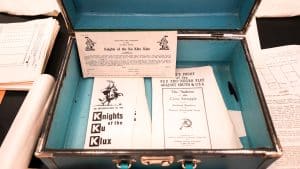
The inventory included file folders that contained news clippings about the Mississippi Highway Patrol, the Mississippi Department of Public Safety, then-DPS Commissioner T.B. Birdsong, and material related to Freedom Riders. All will be processed by the Department of Archives and History to be digitally accessible to the public in the future.
“MDAH is grateful to Commissioner Tindell for recognizing the historical significance of this material and transferring it to the archives,” Incoming Director Barry White said. “These records will give researchers broader access to documentation that deepens our understanding of Ku Klux Klan activities in Mississippi during the 1960s. Receiving a set of materials that includes both administrative records and propaganda from a local chapter of a national organization known for its secrecy is particularly significant.”
Processing the material could take several months, officials say. It involves the arrangement, housing, and description of archival materials for storage and use by patrons. Description will involve writing a collection-level overview for the catalog, including the inventory’s transfer to MDAH from DPS, an item-level finding aid, and index data for the scans that will be produced.