


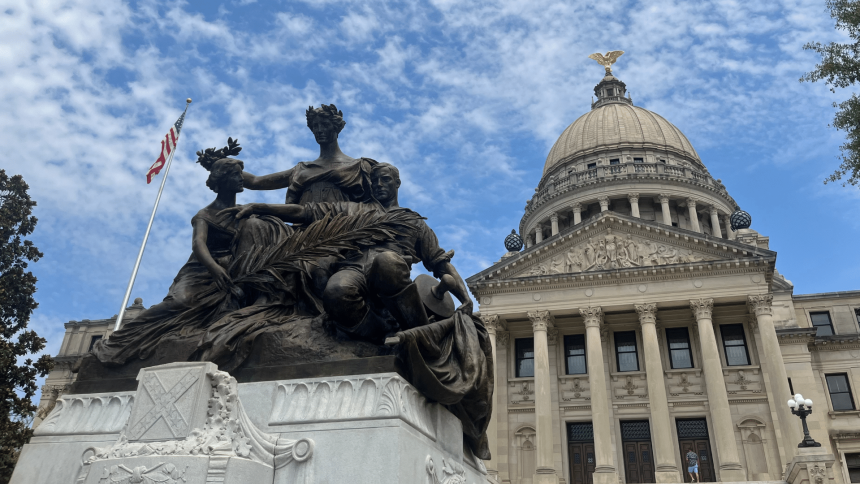
One day after Gov. Tate Reeves announced that Mississippi would not be joining Republican-led southern peers in altering congressional lines right away, Lt. Gov. Delbert Hosemann formed a select committee to assess the prospect of redistricting.
Reeves, who called off the special session originally slated to get underway next week after a federal appeals court threw out a judge’s ruling that the state’s Supreme Court voting map diluted Black voting power, made it clear that while Mississippi won’t tackle redistricting right now, he expects lawmakers to get to work on the topic soon.

“I expect lawmakers to redraw congressional lines between now and 2027 elections! I also expect them to redraw legislative and Supreme Court lines between now and 2027 elections,” the governor stated after originally breaking the news during an appearance on Mornings with Richard Cross.
With that in mind, Hosemann, a Republican, has created a select committee to look at redistricting and reapportionment. House Speaker Jason White, also a Republican, announced a similar committee last week. The committees were formed in response to the U.S. Supreme Court’s ruling in Louisiana v. Callais, with the majority saying state’s cannot lean too heavily on race when drawing congressional lines.
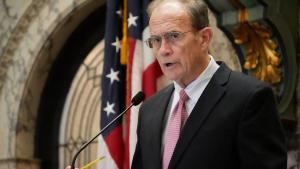
Sen. Dean Kirby (R-Pearl) is chairing the redistricting committee and will be accompanied by Sens. Briggs Hopson (R-Vicksburg), Josh Harkins (R-Flowood), Brice Wiggins (R-Pascagoula), Jeremy England (R-Vancleave), Lane Taylor (R-Philadelphia), Mike Thompson (R-Gulfport), Daniel Sparks (R-Belmont), Derrick Simmons (D-Greenville), and Angela Turner Ford (D-West Point).
“I have full confidence that this committee, led by Senator Kirby, will meet in the coming months to gather information, review data, and evaluate potential future redistricting of congressional, legislative, and State Supreme Court districts in light of the Callais decision,” Hosemann stated. “I look forward to reviewing the committee’s recommendations.”
READ MORE: ‘Time is ticking,’ but Hosemann still mulling governor run
As things stand, eight states have enacted new congressional maps amid a national push by both major political parties to garner a competitive advantage in future elections. Alabama and Louisiana redrew districts but are currently facing litigation regarding their new maps.
Mississippi has four congressional districts, three of which are held by Republicans, with longtime Democratic Rep. Bennie Thompson being the lone member of his party in the state’s delegation. Amid the ongoing campaign by national conservative politicos to turn all of Mississippi’s districts red, some mock maps have floated around on social media trying to show lawmakers that a 4-0 GOP advantage in U.S. House representation is possible.
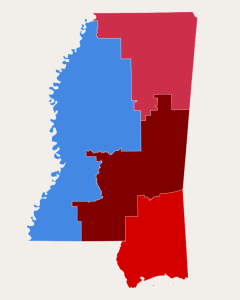
Some Mississippi officials have explicitly called for the state to proceed with redistricting this year. Among those are State Auditor Shad White and Agriculture Commissioner Andy Gipson, who have contended that Thompson has represented his district poorly. Reeves, on the other hand, agrees that Thompson’s tenure of “reigning terror” on the region ought to come to an end but not at this time.
Thompson has continuously vowed to fight any effort to alter his district, and the Mississippi Democratic Party has accused Republicans of a blatant attempt at silencing Black voters.
The reason the governor held off on having lawmakers tackle the map at this point is because Mississippi has already held congressional primaries for the presently-drawn districts this year. Redistricting right now would require lawmakers and Reeves to invalidate the results of those races, which is complicated and would open the door to lawsuits.
“We are in the middle of an election. We’ve already had our primaries. That puts Mississippi in a difficult position,” said Secretary of State Michael Watson, whose office oversees elections. “It’s not as easy folks would say, ‘Let’s just flip the switch.’ It’s easy to say that from the cheap seats when you don’t have to do the hard work.”
In the meantime, elected leaders in both state legislative chambers will take a look at what redistricting would look like before gaveling back in for the 2027 session in January – unless a special session is called before then.