



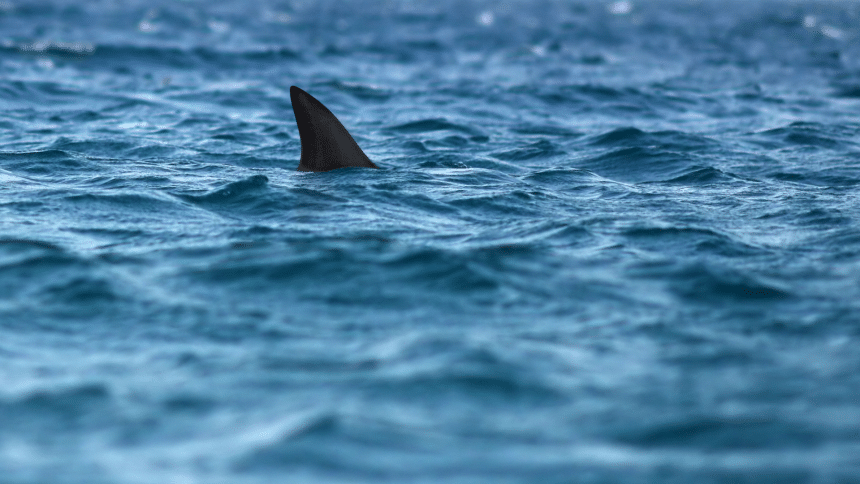
With Discovery Channel’s “Shark Week” underway, many Mississippians might not realize just how many species are swimming off the state’s coastline.
During last year’s “Shark Week,” Dr. Jill Hendon with the Center for Fisheries Research and Development at the University of Southern Mississippi explained that the waters off Mississippi boast “some of the greatest diversity” in all the Gulf, even noting that white sharks can be occasionally pass through deeper waters before moving on.

For this year’s edition of the annual TV event, we caught up with Hendon again to learn more about the species swimming close to home.
“We have been running a survey of shark species in the Mississippi Sound for well over 20 years now, and we routinely will find seven- or eight-foot – sometimes nine-foot – tiger sharks, great hammerheads, and scalloped hammerheads,” she said.
While a shark that large near Gulfport or Ocean Springs may be a startling sight, Hendon said those sharks are still far from full-grown. As they mature, they move farther offshore.
“It’s really interesting because, by far, all off these species are still juvenile,” the shark expert continued. “So, you might be seeing a seven-foot shark, but it’s still a juvenile because the adults go way far offshore.”
According to Hendon, there are approximately nine species regularly inhabit the Mississippi Sound and surrounding barrier islands. The list includes Atlantic sharpnose, black tip, finetooth, spinner, and bull sharks. The Atlantic sharpnose is the most common species in the region and only gets to be about three feet long.
Further offshore – and well away from beachgoers laying out towels or riding boogie boards – large mako sharks are a common sight for Hendon and her team.
“Just south of us, we do get some bigger stuff like makos. They can definitely get into the teens – between 13 and 15 feet, somewhere in there,” she said.
READ MORE: Massive great white shark spotted near Mississippi barrier island
Hendon said that while sharks are undoubtedly swimming in the waters off Mississippi, their presence is no reason to draw a line in the sand and not get in the water. She pointed to two statistics: Vending machines kill more people each year than sharks, and very few shark attacks have occurred in the Mississippi Sound over the past century and a half.
“When we look at the shark attack files that are maintained off of Florida and specifically look at the Mississippi coast, the only quote-unquote provoked attacks that resulted in death were in the late 1800s and the early 1900s,” Hendon said. “So, not even any time within our lifetimes or generations. A lot of the fear is just what we’re saying – irrational.”
Irrational or not, fear is a word often associated with sharks, especially as “Shark Week” has evolved into a mix of cinematic entertainment and educational programming. Hendon believes that fear often turns into fascination, helping explain why the annual event continues to draw millions of viewers.
“For some reason, fear has this way of connecting people internally and really turning that fear into fascination and wanting to basically understand where that fear is something from and if it’s logical,” she said.
When asked whether she enjoys “Shark Week” or believes it promotes the misconception that sharks are mindless, man-eating killers, Hendon had a nuanced answer.
“That’s a tough question for me,” she said. “I came up when ‘Shark Week’ was kind of first starting, and ‘Shark Week’ was really rooted in good scientific data and really trying to present facts and show the role that these animals play in our ecosystem.
“Over time, because people love the fear of things and love that fear factor, a lot of the shows have kind of taken a shift to really draw viewers with that fear factor. And so, we get a lot of sensationalization that happens and I think that needs to be balanced out with the facts, because when you start promoting that and putting more of that out there, you’re sending the wrong message. People may be walking away with a lot of facts about attacks and less facts about the critical role they play in our waters.”