


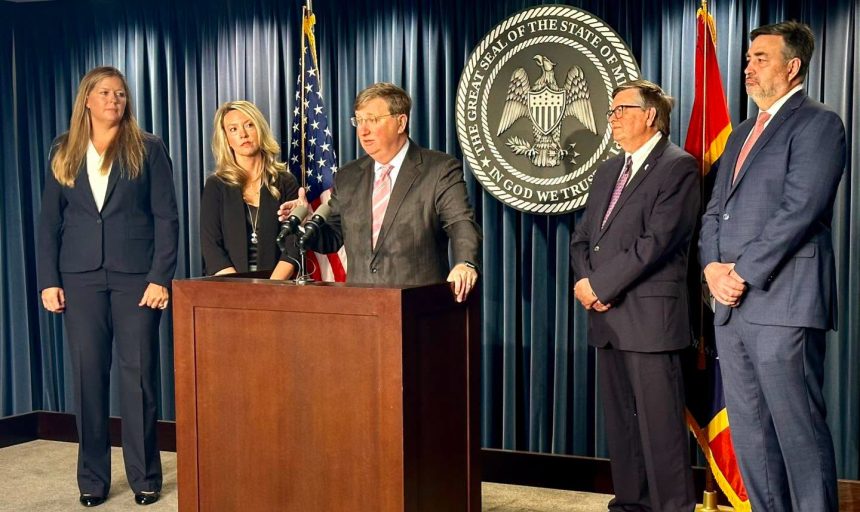
Mississippi Gov. Tate Reeves announced Wednesday that money has been made available through the state’s rural healthcare initiative, while expounding on efforts to meet the needs of residents in underserved areas.
In a press conference, Reeves revealed that $81.7 million has been made available to organizations serving rural Mississippians through three grant opportunities. The governor did not go into detail about the grant requirements but said specifics would be announced at a later date.

“These opportunities help organizations serving rural Mississippians address healthcare gaps, strengthen healthcare technology, and expand telehealth services,” Reeves said of the grants. “We received a tremendous response from organizations across our state.”
The funding comes from a nearly $206 million pool provided to Mississippi by the Trump administration as part of a $50 billion federal program created through the “One Big Beautiful Bill.” The nearly $82 million sum Mississippi is granting to organizations is just the first phase of a greater plan to hand out all of the money the state has been awarded from the federal government.
According to the governor, the state received applications from 236 organizations serving rural Mississippians, requesting more than $676 million in funding. Applications opened July 15.
“The need is greater than the funding available in this first round,” Reeves said. “That’s exactly why getting these decisions right matters. Our job now is to implement this program the right way, deliver lasting results, and continue being good stewards of these dollars.”
Reeves said his Wednesday announcement followed five community outreach meetings statewide, application-specific webinars that reached more than 1,000 stakeholders, and more than 33,700 emails to providers and community organizations being sent.
Rural health plan features workforce and information exchange campaigns
Reeves said the state has introduced a workforce expansion initiative spearheaded by Accelerate Mississippi to recruit, train, and retain healthcare professionals in rural areas. Research from the Rural Health Information Hub found that more than half of Mississippians live in rural areas with scattered healthcare.
The state is looking to modernize how information is exchanged between local healthcare providers. Reeves added that the Mississippi State Department of Health has launched a request for proposal to “bring specialized expertise as we begin designing Mississippi’s statewide Health Information Exchange.”
Emphasis on emergency care
The state health department has begun the request for proposal process for a comprehensive statewide emergency medical services assessment, Reeves said.
The goal is for the assessment to help identify opportunities to strengthen emergency medical services, improve regional coordination, support the local emergency medical services workforce, and develop a practical roadmap for the future of emergency care across rural Mississippi.
Mississippi plans to address behavioral and mental health challenges
Mississippi is also looking to expand psychiatric emergency services to address behavioral and mental health challenges. Reeves said the state plans to use the Emergency Psychiatric Assessment, Treatment, and Healing (EmPATH) model to reach those in need quicker. The EmPATH model provides a specialized emergency department alternative featuring calm, living-room-like spaces and rapid psychiatric care.
On the mental health front, the Mississippi Department of Mental Health is expanding its crisis diversion centers that provide a safe, therapeutic alternative to emergency departments or jail for individuals experiencing a behavioral health crisis.
“And we’re investing in the people who provide behavioral healthcare by expanding access to nationally recognized, evidence-based training programs that will strengthen Mississippi’s behavioral health workforce and improve care for individuals with intellectual and developmental disabilities across rural communities,” Reeves said.
Mississippi looks to curb obesity
The Mississippi State Department of Heath and the Department of Mental Health are partnering to address one of the state’s most pressing medical challenges — obesity.
Mississippi consistently ranks as one of the most obese states in the nation. A 2024 report from the Centers for Disease Control and Prevention found that roughly 40.4% of Mississippians were considered obese. The only state with a higher percentage was West Virginia.
Reeves said the two state agencies will engage in a comprehensive approach built around the principles of the Trump-promoted Making America Healthy Again initiative. Mississippi’s role will combine nutrition, behavioral health, coordinated medical care, and long-term support to help people achieve healthier lives.
The state health department is also launching a remote patient monitoring pilot allowing healthcare providers to better manage chronic diseases while reducing unnecessary travel for patients who live miles away from specialty care.
State aims to offer more services to pregnant women
Another healthcare field where Mississippi finds itself in the cellar is infant and maternal mortality rates.
The state’s 2025 public health report card revealed that Mississippi ranked 50th in infant mortality rates and 49th in maternal mortality. A lack of access to care in some of the most rural regions of the state is considered a major factor in the troubling statistics.
To give pregnant women and children better access to care, the state health department is launching a pilot program designed to eliminate obstetric deserts by deploying fully staffed mobile clinics into communities where women currently have limited or no access to prenatal and obstetric care.
Rural health plan seeks to serve veterans and first responders
Mississippi’s rural health plan also addresses barriers for veterans and first responders. The state plans to give those who served in the military and those who are on the front lines daily alike better access to convenient care, the governor said.
“When you look at everything happening through the Mississippi Rural Health Transformation Program, one thing becomes clear. This isn’t a collection of separate projects — it’s one coordinated effort to improve health outcomes across rural Mississippi,” Reeves said.
The governor has repeatedly asserted that the overarching priority for the rural health initiative is to ensure that every Mississippian will have more reliable access to quality healthcare services by 2031.