

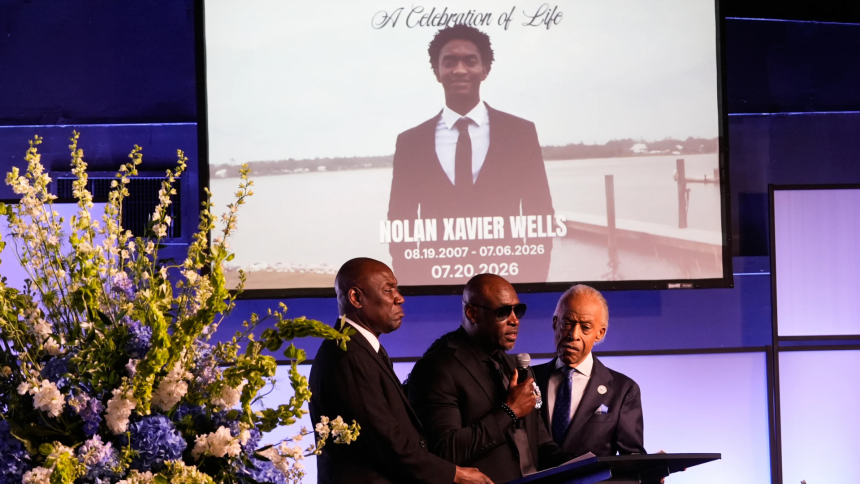
Jackson County District Attorney Angel Myers McIlrath and the attorney representing the family of Nolan Wells continue to spar over how the deceased teen’s case was handled.
After a grand jury determined that there was insufficient evidence to charge any of Wells’ friends who accompanied him to Horn Island on Independence Day, when he went missing, the victim’s family is demanding answers. While Wells’ death was found to be consistent with drowning, the family’s legal counsel highlighted Wells’ cellphone usage the day he disappeared, along with what it found to be inconsistencies with the autopsy and the grand jury’s logic in deducing how the victim passed.

Wells was found dead by a park ranger on July 6, two days after he went missing. The 18-year-old Black student-athlete had last been seen with a group of white friends, sparking rumors that his death was racially motivated, though those have not been substantiated. Family attorney Ben Crump held a press conference on Thursday to provide an update on the family’s stance on the grand jury’s decision not to pursue criminal charges. Crump adamantly expressed that it was inappropriate to close Wells’ case and that the family still lacks answers.
During the press conference, Crump called on forensic expert Andrew Garrett to provide a detailed account of Wells’ cellphone activity from July 4. Wells’ cellphone has, at times, been the center of attention in this case, with the family asserting from the time they recovered it that messages had been deleted.
McIlrath stated that her office was never able to retrieve the phone from the family, but that Crump’s team provided 282 pages of Snapchat, Wells’ preferred communication outlet, conversations for the grand jury to assess. On Thursday, however, Garrett stated something that seemingly confirmed what the family had alleged — that things were deleted from Wells’ phone the day he went missing.
“There were things that were deleted from the phone,” Garrett said during the press conference. “I can’t talk to intent. Unfortunately, that’s not my field of expertise, psychology. But I can tell you from a digital standpoint, things were deleted on the phone from the time he last had the phone up until the time that his parents got the phone.”
Garrett added that Wells last accessed his phone around 2:18 p.m. on July 4. McIlrath, however, insisted that nobody had physically accessed Wells’ phone after his last known use and before his parents received it. As for the deleted items, McIlrath said that action was taken by other Snapchat users on their devices, rather than someone removing information from the victim’s phone. She further contended that if there happened to be evidence of someone tampering with the phone, it would have been presented to the grand jury.
“The Crump team decided to wait until the 11th hour to do a private phone extraction and only provide the Grand Jury with certain portions of the results,” McIlrath said. “That is not the State of Mississippi failing to be thorough in its investigative efforts; that is the Crump team making strategic choices to control the public information on Nolan’s phone and create a misleading public narrative.”
Crump also brought up the state’s autopsy and an independent autopsy conducted by forensic pathologist Dr. Roger Mitchell. After explaining that he did not receive the state’s autopsy until after the grand jury’s ruling, he argued that there were inconsistencies between what medical evaluators found and what jurors decided as the cause of death.
Both autopsies ruled Wells’ cause and manner of death as undetermined. Neither autopsy ruled out drowning as a possible form of death. However, both found a pair of bruises on the back of the victim’s head. A witness told the grand jury that he saw Wells slip awkwardly off the side of a boat on Independence Day. Wells is said to have continued socializing and did not appear to be hurt, per the witness’s testimony. Jurors determined that the bruising was nonfatal and not evidence of foul play.
Crump mentioned that there was no water in Wells’ lungs, stomach, or throat when the autopsies were conducted. Medical experts have weighed in, noting that the absence of water could be a sign of “dry drowning,” where one’s airway spasms shut before water is inhaled. Studies show that dry drowning is the cause of between 10-20% of fatal drowning autopsies.
“The Crump team and Nolan’s family have had my personal cell phone and an open invitation to present anything they wanted to the Grand Jury from the beginning. Instead of choosing the grand jury, they have chosen to grandstand,” McIlrath said. “I know the work that was done in this investigation. I know the people who did it, and I know the lengths to which they went to find the truth.”
The grand jury’s ruling ends the criminal prosecution in this case, though the case could be reopened if evidence of a crime arises. Crump indicated that Wells’ family could pursue civil lawsuits against the people who were with the victim on July 4.