



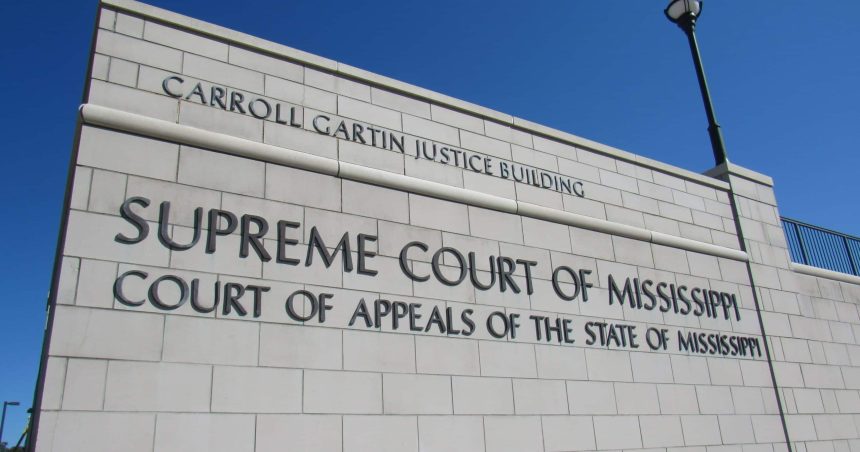
A federal judge’s order requiring Mississippi lawmakers to redraw the state Supreme Court voting map has been canceled.
The U.S. Fifth Circuit Court of Appeals on Monday approved a motion to vacate a 2025 ruling by U.S. District Judge Sharion Aycock that Mississippi had to draw new lines, alleging that the current map dilutes Black voting power.

The judge ordered local lawmakers to redraw the map this past legislative session, but the order was appealed and a decision regarding the appeal was delayed until the U.S. Supreme Court voted on the Louisiana v. Callais case. The nation’s high court, in a 6-3 vote last month, ruled that race cannot be the “predominant factor” in drawing voting districts.
With a ruling from the Fifth Circuit and a precedent set by SCOTUS, Mississippi lawmakers can now choose to keep the Supreme Court the same as it has existed since 1987 or still redraw it if they wish.
Mississippi Gov. Tate Reeves, who ordered a special session to begin on May 20 in the aftermath of the Callais ruling to address the Supreme Court map, celebrated the federal appeals court’s Monday ruling. Reeves has publicly remarked that leaning on race when creating voting districts is both “offensive” and “demeaning.”
“The 5th Circuit just vacated the liability order in our judicial redistricting case. Post Callais, both the plaintiffs and the State jointly requested this action,” Reeves stated. “A good day for those who believe in the principle that all Americans are created equal. A good day for law and order. A good day for Mississippi!”

Meanwhile, the Callais decision has emboldened GOP-heavy states to look at redrawing their congressional maps to add seats more favorable to Republicans by eliminating districts long held by Democrats. Reeves, who sets the agenda for special sessions, has not publicly called on lawmakers to look at Mississippi’s congressional map.
Republican State Auditor Shad White, on the other hand, has urged his GOP colleagues in the legislature to redraw voting lines in a manner that would all but guarantee District 2 Congressman Bennie Thompson, a Democrat in his 17th term in the U.S. House, would not be reelected.
“Mississippi has long had a congressional district – the second congressional district – which was gerrymandered around race. And there is no reason under this new ruling for that district to exist with the lines that it currently has,” White said of redistricting. “This is a huge, huge change in electoral politics and it could mean the end of the district that was drawn specifically to protect Bennie Thompson.”

Republicans have been split on the issue, with some espousing concerns that redrawing the congressional map could backfire in the future. Secretary of State Michael Watson, who oversees elections in Mississippi, further argued that changing the voting map would be gravely difficult because the state has already held congressional primaries this year. Altering the map would require the legislature and governor to invalidate the results of those races.
“We are in the middle of an election. We’ve already had our primaries. That puts Mississippi in a difficult position,” Watson said. “It’s not as easy folks would say, ‘Let’s just flip the switch.’ It’s easy to say that from the cheap seats when you don’t have to do the hard work.”
Prominent Democrats in Mississippi argue that Republicans, like Reeves, are disingenuous when saying voting maps should not be predicated on race. State Rep. Cheikh Taylor, who heads the Mississippi Democratic Party, accuses officials from the other party of using that narrative as a mask to cover their actual agenda — to reduce the power and influence of Black voters.
“This special session has nothing to do with compliance or fairness. It is about power, and making sure Black Mississippians never have enough of it to threaten the people who currently hold it,” Taylor said.
Thompson has also vowed to fight any effort to combat any efforts to alter his district, saying that SCOTUS’ ruling will not stop him from “taking this system head-on” alongside his Congressional Black Caucus colleagues.
As things stand, Mississippi lawmakers have not been tasked with changing the congressional map this year. However, Republican House Speaker Jason White has created a select committee focused on redistricting efforts in 2027.