



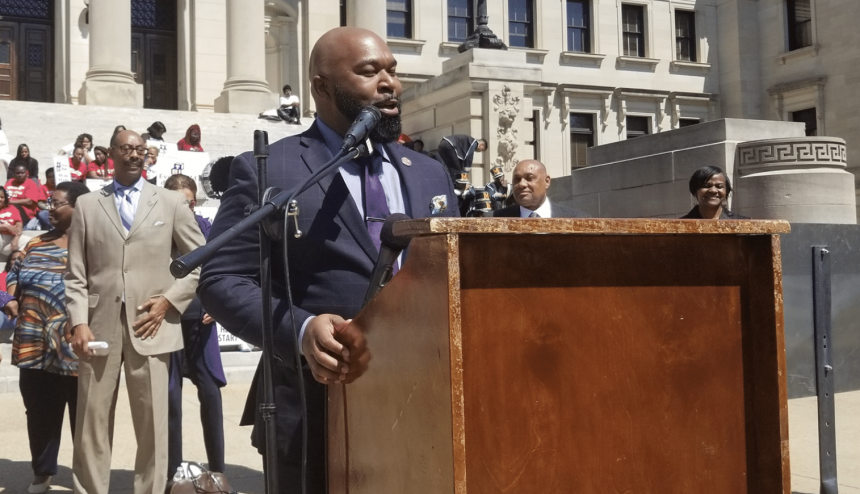
Lawmakers in Mississippi will reconvene in Jackson in two weeks with Gov. Tate Reeves asking them to redraw the state’s Supreme Court electoral map, though some predict congressional districts could become a topic of conversation. Either way, Mississippi Democratic Party Cheikh Taylor believes his Republican colleagues, who boast majorities in both legislative chambers, are seeking to intentionally dilute Black voting power.
Reeves ordered the special session to occur 21 days after the Louisiana v. Callais case was decided by the U.S. Supreme Court. The case centered on a second majority Black congressional district created in Louisiana, with challengers arguing that creating race-based districts was unconstitutional. In a 6-3 ruling, SCOTUS ruled that Louisiana’s Democratic-represented district had been egregiously carved out based on race, opening the door for other Republican-led states to redistrict.

While Reeves, who sets the agenda for special sessions in his capacity as governor, has not publicly expressed an appetite to alter the state’s congressional map, there has been a push from within GOP circles. Notably, State Auditor Shad White has explicitly called on Mississippi lawmakers to eliminate Democratic Congressman Bennie Thompson’s district as it currently stands, while President Donald Trump has also pressured Republican states to redraw maps.
“Mississippi Republicans could barely contain their excitement after the Supreme Court’s ruling in Louisiana v. Callais. Some are already calling to eliminate Bennie Thompson’s congressional district entirely and hand every seat in this state to Republicans,” Taylor said. “Now, Donald Trump himself is personally pressuring Mississippi officials to do exactly that.”
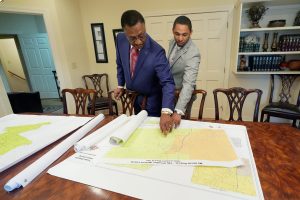
An effort to redraw the congressional map in Mississippi would be difficult, given that the state has already held congressional primaries this year. Redrawing districts would require both the legislature and the governor to invalidate election results, which would open the door to legal challenges and voter confusion.
At this time, there is doubt amongst those with desks inside the capitol that Mississippi will make the move to create what would appear to be four Republican-heavy congressional districts in the special session. Not only does the current election cycle potentially throw a wrench in the idea, but some Republicans believe a redrawn map could open the door to more “purple” districts long-term.
“We’ve got to use common sense in this. 3-1 may be the best we can get,” state Rep. Sam Creekmore, R-New Albany, said, referring to Mississippi having three GOP congressional seats and just one held by a Democrat. “In my experience with special sessions, there’s a limited agenda, and you try to get everything worked out before you get down there, and we’re not typically there for a long time. I would be surprised if we expanded to the congressional map.”
Regarding the state Supreme Court voting map, a federal judge previously tasked lawmakers to create districts that do not drown out Black voting power, with the current map being accused of doing so. With the Callais decision, however, a precedent has been established that it is unconstitutional to rely on race when drawing districts.
This means lawmakers could keep the map the same or even alter it in a way that gives Republican-leaning candidates an even greater advantage, despite the notion that Supreme Court justices are to be independent of party affiliation.
The special session is scheduled for May 20, but the House and Senate will be meeting in different buildings. The Senate will gather at the state capitol, while the House will meet in the old capitol building — a place where former Mississippi lawmakers elected to secede from the United States and to enact Jim Crow laws — as the chamber’s current quarters undergo renovations.
Taylor, a member of the House in addition to his leadership role in the Mississippi Democratic Party, finds it symbolic that he and his peers will gavel in at a building stained with a dark history when meeting for a session he believes is rooted in a malicious intent to marginalize Black citizens.
“This special session has nothing to do with compliance or fairness. It is about power, and making sure Black Mississippians never have enough of it to threaten the people who currently hold it,” Taylor said. “And now they plan to do it in the Old Capitol, the same building where Mississippi voted to secede from the Union over slavery, and where white supremacist delegates crafted the 1890 Constitution that stripped Black citizens of their voting rights and ushered in decades of poll taxes, literacy tests, and racial terror.”
Reeves, on the other hand, argues that relying on race to draw districts is prejudiced, saying upon announcing the special session, “when the government classifies its citizens on the basis of race, even as a perceived remedy to right a wrong, it engages in the offensive and demeaning assumption that Americans of a particular race, because of their race, think alike and share the same interests and preferences.”