


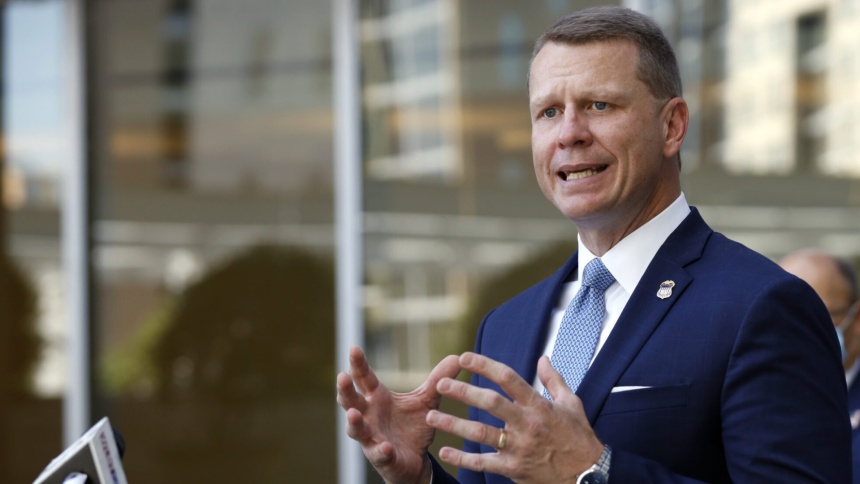
Mississippi GOP chair Mike Hurst said Monday that Gov. Tate Reeves was correct to call off the state’s special session but believes there is a way for state lawmakers to draw four Republican congressional districts after November’s midterms.
“Unfortunately, we already had our primaries in March. It was a tough decision for the governor,” Hurst said during an appearance on Mornings with Richard Cross. “I think he made the right decision, but at the end of the day, Bennie Thompson’s days are numbered.”

Hurst is among a group of Republicans pushing the GOP-led legislature to create a new map that would make it more difficult for longtime Democratic U.S. Rep. Bennie Thompson to be reelected after this year’s cycle. Reeves is also part of that group, writing on social media after calling off the session intended to redraw the state’s Supreme Court map – not the congressional map – that Thompson’s “reign of terror…is over.”
However, the problem that both Hurst and Reeves are seeing is the timing of it all.
Mississippi held its congressional primary election on March 10, and with five and a half months until the general election, both say there is not enough time to redraw the congressional map, invalidate primary results, and hold another primary election before the scheduled Nov. 3 general election. If done that way, intense litigation would be inevitable, Hurst said.
“We the party would have to spend money on litigation, on lawyers, on legal fees to try to fight that in court,” explained Hurst, who is a former U.S. attorney. “It’s just not enough time to try to turn around and get that done. I would much rather we spend donors’ money on getting Republicans elected [now] rather than paying lawyers in the courtroom.”

Mississippi is caught up in a national wave of Republican-led states looking to redraw maps to give GOP congressional candidates an even greater advantage following a landmark U.S. Supreme Court decision last month. Louisiana v. Callais resulted in a majority of justices ruling that districts cannot be drawn with race as a predominant factor, giving states more leeway to use party affiliation as a defense when drawing maps.
Some Republican-led states, such as Louisiana, South Carolina, and Tennessee, have already moved forward with redraws. Some Democratic-led states, most notably California, have done the same to benefit their majority party. Litigation is expected in every state where redraws occur, if it has not already been filed.
As for how Republicans could redraw congressional lines in Mississippi, it’s a “complicated” matter, according to Reeves.
Some Republicans, such as State Auditor Shad White and Agriculture Commissioner Andy Gipson, are still calling for an immediate redraw. Other Republicans, including state Rep. Sam Creekmore, have warned that a quick, careless redraw could be beneficial to their party short-term, but long-term, it may backfire if ingrained blue votes in Thompson’s district are moved to other areas that could eventually turn purple.
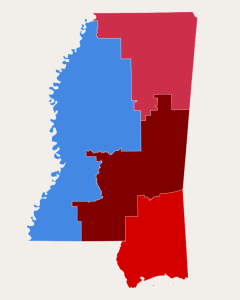
Mississippi has four congressional districts, three of which are historically Republican and the other Democratic. Mock maps have circulated on social media from voters and political commentators attempting to show lawmakers how a 4-0 situation heavily in favor of Republicans is possible. Both Reeves and Hurst believe there is a path for Republicans to win all four seats, but it’s not as easy as some online proposals suggest.
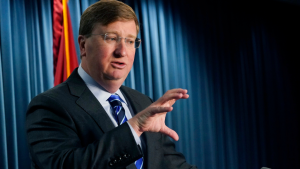
“I will tell you that I’ve seen these maps going around the internet that show four, R+20 districts. Those are not realistic,” Reeves said.
“I know this is shocking that you can’t believe everything you see online, but some of the maps that you see online with +20 in four districts is just dumb. It’s ridiculous. But I have seen maps where they are politically Republican-majority,” Hurst added.
Either way, it appears Republican lawmakers will work to draw and vote on a new congressional map after the midterms – unless Reeves changes course beforehand. House Speaker Jason White and Lt. Gov. Delbert Hosemann, both Republicans, have created committees focused on redistricting ahead of the 2027 session.
But to carry out any redraw, several factors must be considered by the party with control inside the state capitol.
One is how to create a map that is favorable to Republicans without completely splitting areas with shared interests. For example, the Coast – currently in the fourth district – is largely focused on shipbuilding and military, while the Delta – which Thompson represents nearly in full in the second district – is largely focused on agriculture and is the state’s most economically impoverished area. Having one person represent those kinds of areas often streamlines the process of getting federal support.
Another factor would be creating four districts that are virtually equal in population. The U.S. Constitution requires districts to be as equal in population as possible to ensure one person’s vote carries the same weight as another’s.
A third on a list of many more factors is where current Democratic votes in the second district are distributed to. Shifting some into the DeSoto County area, outside Memphis, Tenn., could cause concerns among Republicans. Then, the staunchly blue Hinds County – with more than 164,000 active voters – would also be a major point of conversation before any redraw.
Despite these concerns, Hurst asserts that a new map is a must because the current one is “rigged” and “unconstitutional” in light of the Callais decision. It remains unclear if the current map, if kept, would survive a legal challenge.
“It’s exciting that the Supreme Court got that right, but we still sit here today and have an unconstitutional congressional district that Bennie Thompson represents,” Hurst said, adding that the second district was purposely created as a majority-minority district in 1982, after a federal court ruled the state was diluting Black voting power.
Thompson, who is so far bearing the brunt of the redistricting conversation in Mississippi, has vowed to keep fighting for his seat and the current configuration of his district.
“When we do not stand up, Black and Brown voters do not just lose a voice, we lose ground in housing, education, healthcare, economic opportunity, and civil rights,” he wrote on social media earlier this month. “Let’s be clear. This fight over redistricting has never been about protecting your vote. It has always been about protecting their power.”