


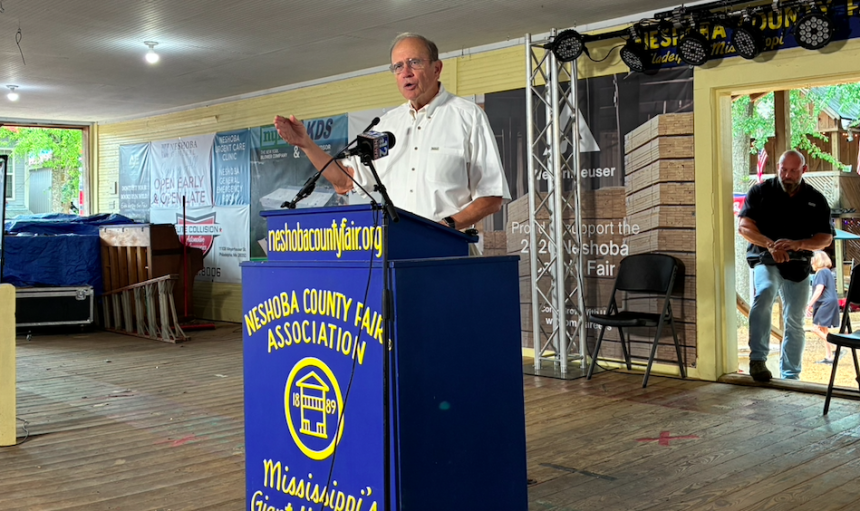
During his annual stump speech at the Neshoba County Fair, Lt. Gov. Delbert Hosemann spent much of his more than 15 minutes behind the podium highlighting education policy while also offering a few noteworthy comments on congressional redistricting.
On education, the Republican touted legislative accomplishments from the most recent session aimed at improving classroom outcomes and supporting those responsible for educating Mississippi’s K-12 and college students. Hosemann noted that the state fully funded public education for the third consecutive year, approved another teacher pay raise, required high school students to complete a civics course before graduation, and passed measures to address chronic absenteeism.

“How did we build this country for 250 years?” Hosemann asked rhetorically. “[K-12 students] can’ even tell you what the three branches (of government) are. Civics is very important for Mississippi, and we put it in this year.
“We also fully funded education for the third year in a row. That’s never been done in this before. A year ago, when I stood here, I said we had a teacher pay raise but we needed another teacher pay raise. So, we had another teacher pay raise.”
Hosemann also pointed to legislation aimed at strengthening the role of school attendance officers in combatting chronic absenteeism. Beyond enforcement, he said the state is working with education leaders to make students feel more connected to their schools. One recent example, he said, is a partnership with Mississippi State basketball player Josh Hubbard to encourage students to attend class.
“I’ve been going to a lot of schools, and in those schools, they say they have chronic absenteeism. Sometimes, 20% and 30% are chronically absent,” Hosemann said. “They can’t learn if they’re not in that seat. This year, we added these so-called attendance officers who are knocking on doors.
“[Students] have to want to come back. For them to come back, the school has to make them feel welcome. If they’re part of the band, on the football team, on the debate team, they have to feel like there is a reason to come to school.”
Hosemann also said Mississippi must be proactive in meeting the needs of students with disabilities. Speaking with reporters after his speech, he said the issue is personal because he has a grandchild with Down syndrome while also noting the growing number of children across the state with special needs.
According to the Centers for Disease Control and Prevention, one in every 31 American children is identified with autism spectrum disorder. In a state with high poverty rates, like Mississippi, it’s important to Hosemann to support existing programs at local universities, where educators are trained to meet the learning needs of special needs youth, while also teaching them to become as independent as possible. He further proposed the creation of regional centers focused on special needs education.
“Mississippi State University and Ole Miss have fantastic programs to teach these kids and how to be successful in their lives. We need to support those [programs]. We need regional centers for schools that can’t cover their own people,” Hosemann said, further highlighting the work being done at Mississippi State.
“We have one of the best places in the country at Mississippi State, training up to 50 of these teachers every year in a master’s [program] to come out and work with these kids. Under our programs, they get a scholarship if they stay in Mississippi. That has changed the paradigm.”

A hot-button issue over the past few sessions has been school choice, with Hosemann’s legislative counterpart, House Speaker Jason White, listing what he calls “education freedom” at the top of his agenda. For Hosemann, the school choice debate centers on a completely different agenda than offering parents the ability to transfer their children from one public education center to another, and that agenda is to pass legislation allowing taxpayer money to go to private schools.
“We proposed school choice among public schools and the House killed it, so we had a school choice bill,” Hosemann said, referring to Senate Bill 2002. “The debate needs to focus on whether or not we want to give money to private schools. Let’s just all be honest about it.”
Hosemann added that he’d be willing to debate the merits of public money going to private schools, though he raised concerns over the legality of it along with the possibility that private institutions with religious courses not having an appetite for government funding with potential strings attached.
What Lt. Gov. Hosemann said about redistricting
The redistricting conversation dimmed down in Mississippi after Gov. Tate Reeves called off a previously scheduled special session to redraw the state’s Supreme Court electoral map. But that doesn’t mean work isn’t being done behind the scenes, especially with a reported push from the White House for Mississippi to find a way to turn all four of its congressional districts red. Currently, three U.S. House seats are occupied by Republicans with Rep. Bennie Thompson being the lone Democrat.
Hosemann and White have both formed select committees to look at redistricting, especially in the wake of the Louisiana v. Callais decision, where the U.S. Supreme Court ruled that states cannot lean on race when drawing voting maps. Previously, Mississippi had to redraw 14 legislative seats at the state level due to a federal judge’s ruling that the former map diluted Black voting power. The same applied to the state Supreme Court map.
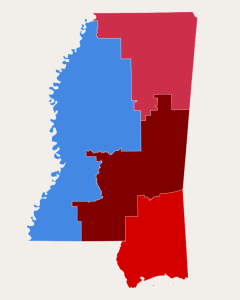
However, with those rulings being effectively superseded by the nation’s high court, some Republican officials in both the federal and state ranks have launched campaigns to redistrict. In Mississippi, the process of getting the ball rolling on redistricting has seemingly been kickstarted by a letter Secretary of State Michael Watson penned to Hosemann and White, giving them relevant deadlines ahead of upcoming elections.
“We’re going to redistrict Mississippi,” Hosemann said. “One of the few rights we have as a state is the right to set the way we elect people and their districts. When we tried to redistrict Mississippi the way your legislature, the people you hired, wanted to redistrict Mississippi, a federal court said, ‘No. You can’t do it that way. You have to redistrict another way. We want other people elected. The Democrats used that to make sure they elected Democrats, and not the people you wanted.”
Hosemann predicted that districts across the board — congressional, legislative, and Supreme Court — will be modified, but in a manner where race is not the determining factor. The lieutenant governor added that the Senate committee he formed will assess the state’s population and regions, then attempt to draw lines that adequately represent various areas as a whole.
One of the redistricting proposals pushed among some of Hosemann’s elected colleagues, most notably State Auditor Shad White, is to oust Thompson from office. Hosemann elected not to weigh in on the prospect of drawing maps that would directly go after the longtime Democratic lawmaker’s seat.
“We have four districts in Mississippi, and we’ll be lucky to keep them as our state’s [population] is going. I’m not getting into one congressman or another congressman. I want 750,000 people in each one of those districts who are chosen by the people they elect,” Hosemann said. “We have four [districts], and those four will be redistricted in accordance with all these hearings we’re going to have, and what the legislature votes on.”
Several sources and lawmakers have told SuperTalk Mississippi News that a special session on redistricting will likely occur in the late fall of this year. In the meantime, the state’s current congressional map will be in effect when midterms roll around on Nov. 3.