



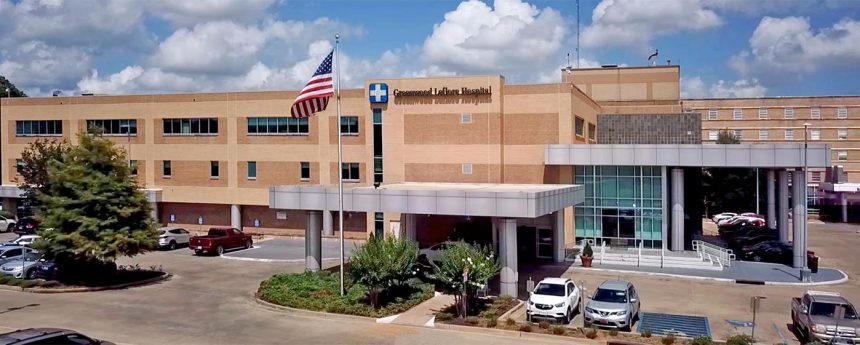
In an effort to continue serving patients in the Mississippi Delta, while also negotiating a potential deal with the state’s largest public healthcare system, Greenwood Leflore Hospital has filed for bankruptcy.
The medical center, which has been at the forefront of the state’s rural health care crisis, took its case to the United States Bankruptcy Court for the Northern District of Mississippi on Wednesday, contending that it is unable to pay its debts. The move comes after Greenwood Leflore Hospital (GLH) laid off 86 staffers and shuttered multiple departments last week, as it remains embattled in a legal dispute with the Mississippi Division of Medicaid.

The Division of Medicaid is seeking to recoup $5.5 million in overpayments to GLH, which is jointly owned by the city of Greenwood and Leflore County. To date, GLH has repaid $2 million of what it owes but has attempted to avoid paying the remaining $2.5 million due to concerns that doing so would shut the hospital down.
GLH is also in talks with the University of Mississippi Medical Center over a potential takeover, Wednesday’s court filing confirmed. GLH administration has expressed interest in UMMC gaining full control of the health care facility’s operations and ownership of its facilities. The move follows 2022 talks between the two parties over UMMC potentially purchasing the hospital, though those discussions ultimately hit a dead end.
But now, with UMMC back at the negotiating table, GLH is in federal court for the second time in as many months. In addition to the bankruptcy filing, the hospital recently a federal judge to halt all scheduled payments to the Division of Medicaid to not only to avoid the hospital closing but also to protect its chances of being taken over by UMMC. The request was granted in March with all payments put on hold for the time being.
“GLH has been and is currently unable to pay its debts as they come due, which conditions were brought on near the end of the pandemic period and have continued since that time,” former GLH CEO Gary Marchand, who now serves as a board consultant for the hospital, wrote in the bankruptcy court filing. “GLH has no means to pay its debts as they come due prospectively. This is true even with the imposition of an automatic stay and accounting for the continued stay of recoupments by [the Division of Medicaid].”
Even with payments being halted for now, GLH lacks the recurring revenue to remain afloat and needs more time to negotiate a possible UMMC takeover. The hospital has been running on a combined $11.4 million of capital in the form of cash, utilities, and a $7.5 million working capital line of credit that was allocated in 2023 and 2024, per the court filing. GLH, in an attempt to prevent its doors from closing for good, has also sold $3.6 million worth of “unused capital assets.”
But all of those dollars are temporary, and if no action is taken by the federal court, GLH is likely to shutter come June 15.
The hospital specifically filed for Chapter 9 bankruptcy, which allows public entities like cities, towns, counties, school districts, and even government-owned businesses to restructure their debt. It acts as a last resort, protecting them from creditors while they develop a plan to adjust debt obligations.
“GLH needs the relief provided by Chapter 9 to effectuate a plan to rearrange its debts and repay its creditors,” Marchand continued. “GLH has been engaged in negotiations with the University of Mississippi Medical Center to acquire certain of GLH’s assets to ensure continued healthcare to the residents of Leflore County and the Delta region.
“In order for this transaction to occur, GLH needs the time, protections, and processes provided under Chapter 9 to effectuate the transaction as a foundation for its plan of arrangement. It is also a certainty that GLH will face a liquidity shortfall in the near-term. No matter the outcome of these proceedings, GLH still needs bankruptcy protection to implement a plan of arrangement that maximizes recoveries to creditors.”
GLH’s path to filing for bankruptcy was largely made possible by the state legislature passing Senate Bill 3230 this past session. The legislation allowed GLH to pursue a path of restructuring its debts to keep talks with UMMC alive. UMMC taking over the Delta hospital is looking to be the best available solution, as the city of Greenwood and Leflore County lack the money to sustain the medical facility.
As things stand, the hospital has 425 employees on site to perform critical services. The 25-bed acute facility is still offering 24-hour emergency care, cardiology, orthopedics, oncology, and diagnostic imaging.
GLH has been in operation since 1906 and sits in a city with a population of approximately 14,000 residents, though the medical center assists patients from other parts of the Delta. If it were to close, the nearest hospital for residents would be roughly 35 miles away at UMMC’s Grenada campus.